


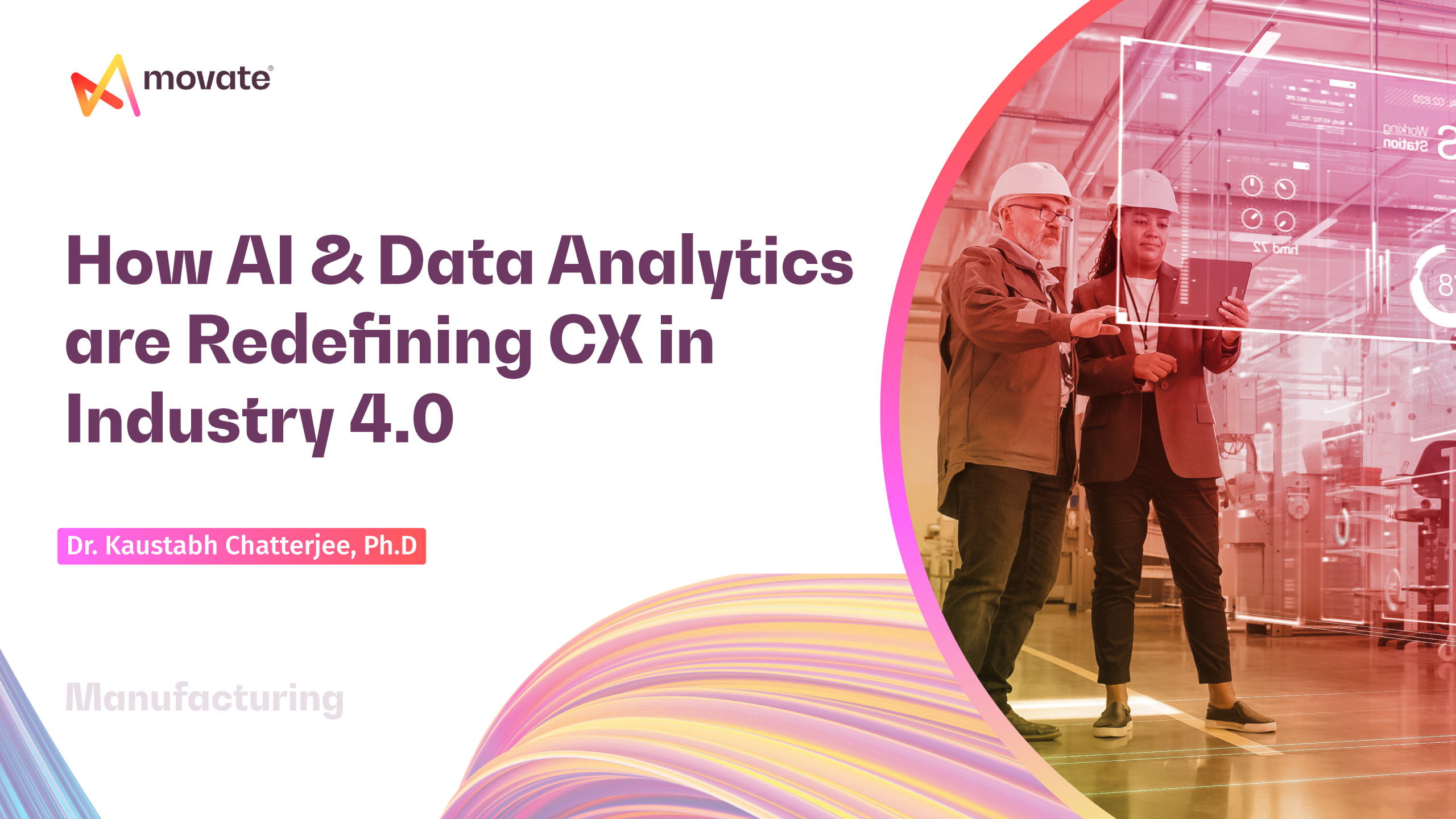
CX has always been considered swinging between either sales interactions or support responsiveness. However, for manufacturing-oriented firms, customer experience largely originates deep within operations long before a product even reaches the market. Thereby, the concept of reliability comes into the picture, i.e., how reliably products are delivered, how consistently they perform, how predictable quality is, and how transparently an organization operates.
Industry 4.0 has fundamentally redefined this reality. At its core lies data that is often called the new oil. Analogous to crude oil, data must be refinedto generate value. AI, ML and advanced analytics are refining processes that transform raw operational data into ‘decision intelligence’ for driving measurable enhancements in business outcomes; this is exactly Movate’s sweet spot to help clients across the manufacturing sector to transform raw data into tangible outcomes.
In this blog (references listed at the end) we will look at :
- The data-driven enterprise
- From data to decision intelligence
- Real ROI from analytics
- Human-in-the-loop is critical
- Designing CX instead of fixing problems
- Funneling refined data into CX
Industry 4.0 and the Data-Driven Enterprise
The term, “Industry 4.0” has become a buzzword lately and rightfully so for its non-singular technology; it entails a convergence of tech entailing analytics-led decision frameworks, cloud platforms and digital infrastructure ecosystems, and IoT sensors and the rest. The panoply of systems continually flesh out operational data: from machine health performance, process-related parameters to throughput, energy consumption and metrics on environmental impact.
Market forecasts indicated that global AI in manufacturing market is growing rapidly, with some projections estimating growth from USD 34.18 billion in 2025 to USD 155.04 billion by 2030 at a CAGR of 35.3%.
The scale and speed of this growth underscore the increasing reliance on AI and analytics to optimize operations at a large scale [1].
Other contemporary research highlighted that industrial AI applications accounted for more than USD 43.6 billion in 2024, with estimates projecting growth to nearly USD 153.9 billion by 2030 at a ~23% CAGR, reflecting strong global investment in AI-driven optimization [2].
From a CX perspective, this is an important aspect to understand because customers experience outcomes, not processes. Variability is curtailed and reliability is increased when decisions are backed by data instead of intuition.
From Data to Decision Intelligence
Manufacturing operations and scenarios are rife with various uncertainties, ranging from fluctuations in materials, tooling, operating conditions, to the process workflows; conventional rule-based models have a tough time to account for the complexities in the real-world scenarios. AI/ML overcome these complexities via learning the ‘patterns’ directly from data, thereby providing predictive and prescriptive insights instead of tardy and sluggish reactive responses.
At Movate, AI-powered data analytics services shed light on decision intelligence, where data channels, mathematical models, and domain expertise come together to support confident decision-making. Instead of simply focusing on past performance, analytics driven by AI answer sensitive and vital operational queries:
- What is likely to happen next?
- How confident is the estimate?
- Which action minimizes downstream risk?
This shift from descriptive to predictive and prescriptive decision-making forms the core of an ‘experience-led’ manufacturing, thereby enabling predictable delivery, consistent performance, and fewer unpleasant surprises for the end customers.
Numbers That Matter: Real ROI from Analytics
To make this tangible, consider how predictive analytics reasonably enhance operational outcomes:
| Outcome Metric | Reported Improvement Range |
| Downtime Reduction | 30%–50% reductions in unplanned downtime [3] |
| Maintenance Cost Reduction | Maintenance costs reduced by ~25% [4] |
| Predictive Analytics Market Growth | USD 1.6B to USD 6.6B by 2033 (~16% CAGR) [5] |
The aforementioned numbers indicate measurable improvements in how operations are managed, and are directly associated with improved CX metrics such as on-time delivery and quality stability, leading to a reduction in downstream disruptions.
Human-in-the-loop is critical
An important aspect of the success of Industry 4.0 is that AI augments/empowers humans and their judgment. In a sector like smart manufacturing, where context is everything, domain expertise of humans is essential for formulating problems, validating insights, and interpreting results to the leadership in a compelling manner.
The team at Movate focuses more on the ‘human-in-the-loop’ analytics, combining domain knowledge with data-driven adaptability. This ensures that models remain grounded while delivering insights that are actionable and reliable, thereby forming a vital basis for customer confidence in product outcomes.
Laser Focus on Designing Customer Experience
One of the most transformative views of Industry 4.0 analytics is the paradigm shift from reactive problem resolution (fixing problems) to proactive experience design. Data-driven simulations or digital twins, what-if analyses, and digital representations allow decisions to be tested before they are implemented on the factory floor, reducing risk and improving agility.
These capabilities shorten learning cycles, reduce operational risk, and improve responsiveness to evolving customer expectations (all of the aforementioned tech capabilities deliver on superlative CX).
Funnelling Curated Data into Customer Experience
To conclude, the industry 4.0 era is rife with data, and insights extraction from plethora of data needs to be intentional; AI/ML and advanced analytics offer such refinement to translate raw/unstructured data into insightful decisions that elevate CX even before the product reaches the market.
The manufacturing firms that win will be those that treat data not as a by-product of operations but as a strategic asset for experience design.
At Movate’s Service Transformation unit, we help organizations leverage AI and analytics to translate data into trusted, reliable, and consistent experiences via analysis that engineer customer satisfaction.
REFERENCES
- Artificial Intelligence in Manufacturing Market Size, Share, Trends and Growth Drivers 2032 (Accessed on 23/01/2026)
- Industrial AI market: 10 insights on how AI is transforming manufacturing (Accessed on 23/01/2026)
- Boost ROI with Predictive Analytics in Manufacturing (Accessed on 23/01/2026)
About the author

Dr. Kaustabh Chatterjee is part of the Service Transformation team at Movate. He is a mechanical engineer-turned data scientist with a passion for solving complex industrial problems through intelligent, scalable solutions. With a PhD focused on effective data utilization in manufacturing from IIT Guwahati, his work bridges traditional engineering with modern AI, enabling smarter decisions on the shop floor and beyond.
His journey spans hands-on roles in steel processing (Tata Steel), academia (Assistant Professor), and advanced research in turning and forging using regression, fuzzy logic, and Kalman filtering. Dr. Kaustabh has built central data repositories, filtered noise from messy industrial datasets, and crafted predictive models that not only estimate but explain. LinkedIn.