
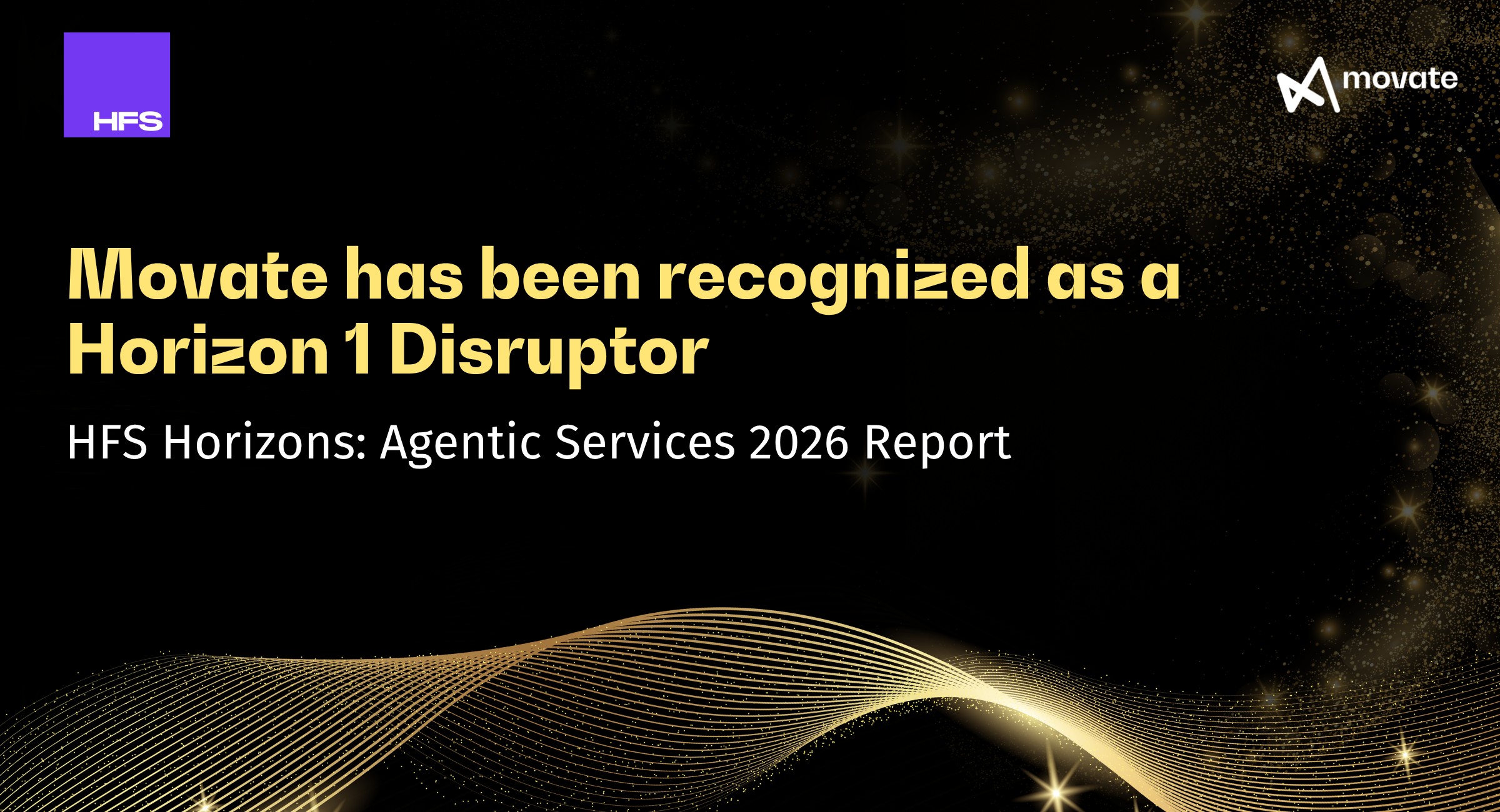
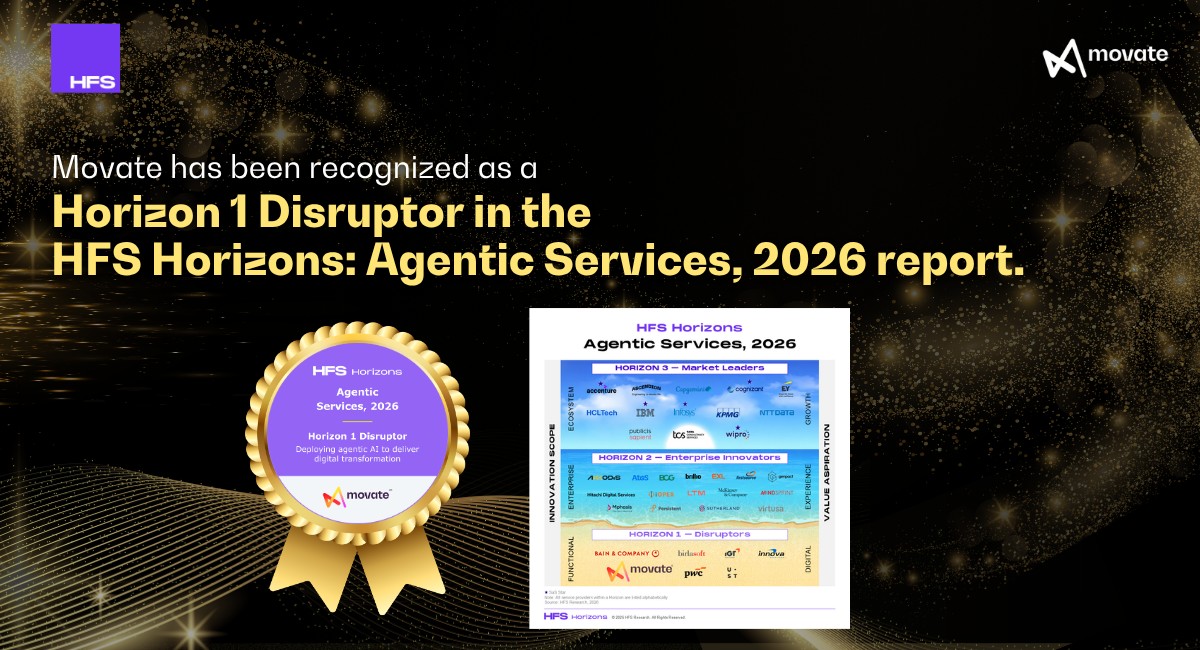
Movate has been recognized as a Horizon 1 Disruptor in the HFS Research Horizons: Agentic Services, 2026 report. Enterprises are moving from experimentation to production-grade agentic AI, where agents don’t just assist, but execute and optimize workflows end-to-end. Movate brings CX-first agentic services across operations, engineering, and analytics; context-driven AI with strong governance and data foundations; and, platform-led offerings like OnDemand, Quality Soundboard, and SDLC accelerators. Click here to access the complete report.
Key Takeaways
- CX-first agentic strategy
- Context-driven intelligence with responsible AI
- Platform-led offerings & repeatable offerings
- Scaling up & ecosystem strength
Being placed at Horizon 1 is a recognition of trajectory, execution quality, and the ability to push the market forward.
“Movate stands out for its CX-led agentic strategy, leveraging its strengths across customer operations, engineering, and analytics to operationalize intelligent workflows that enhance customer engagement, optimize service delivery, and drive scalable efficiency gains.” — David Cushman, Executive Research Leader at HFS Research.
CX-First Agentic Ecosystems
Movate’s positioning in this report comes down to a specific thesis: that great agentic AI in the enterprise has to start with CX, and not with the technology itself. That’s a meaningful distinction.
A lot of agentic AI initiatives get built around capability demonstrations. Movate’s approach flips that. The company architects what the report calls “CX-first agentic ecosystems.” It starts with AI data readiness and FAIR principles (making data findable, accessible, interoperable, and reusable), and layering in context-driven intelligence from there.
AI is shaped by the customer journey, not tacked onto existing workflows.
The technical backbone here involves MCP/A2A integration and what Movate calls Mindful AI. This is a policy-aware approach to deployment with auditable, human-in-the-loop guardrails. That’s a direct response to one of the biggest enterprise anxieties around agentic AI: how do you trust it when it’s acting autonomously?
The Scale Behind the Strategy
Movate has built a dedicated agentic services organization of more than 220 FTEs. It operates 3 delivery centers in India and three AI Innovation Labs, with plans to expand through targeted acquisitions in CX, ITSM, analytics, and Salesforce-led workflows (HFS Research, 2026). The company also runs deployments on AWS and Microsoft Azure.
This isn’t a proof-of-concept operation. The scale reflects a deliberate bet that agentic services aren’t a feature to be added to existing delivery models, but they’re a new delivery model entirely.
Because “Outcomes” Matter
The HFS Horizons report includes some of the outcomes that are worth reflecting on.
Movate ran a gift card redemption process as a fully autonomous digital customer experience service for a global consumer brand across three lines of business, using advanced routing, anomaly detection, and real-time validation. The results: 99% SLA compliance, a 65% reduction in mean time to resolution, and a 50% drop in agent staffing requirements. That last number is the one that rewrites a workforce model.
Separately, a global enterprise deployed an agentic service desk alongside DevOps copilots and saw engineer productivity improve by over 25%, with 98% ticket-routing accuracy. A multinational services organization, meanwhile, reduced total cost of ownership by 20% and automated half of all installation bookings by consolidating CX operations.
These aren’t projections. They’re delivered outcomes, which is precisely what the Horizon 1 designation is built to recognize.
The Shift Toward SAS
One of the most telling lines in the report is tucked under “Evidence of shift toward Services-as-Software.”
The traditional managed services model, where humans handle processes with software as a support tool, is giving way to something inverted: software-led execution with humans providing oversight and escalation.
Movate’s repeatable offerings: OnDemand for CX outcomes, Quality Soundboard for continuous QA/QC, and Agentic App Engineering Accelerators for SDLC are designed to sit on top of existing CRM, ITSM, CCaaS, and SDLC investments. The pitch isn’t replacement; it’s amplification. That’s a less threatening and arguably more realistic narrative for enterprise buyers who’ve already committed to platforms like Salesforce or ServiceNow.
Enterprise AI: Scaling on Trust
Enterprise AI doesn’t scale on capability alone. It scales on trust, which is specifically about whether buyers believe a provider will behave responsibly when something goes wrong. The report notes that a client specifically called out Movate’s agility and collaborative delivery, while a partner highlighted the company’s clear AI strategy, deep engineering and CX capabilities, and a flexible, risk-sharing approach.
Risk-sharing is an underrated signal. It suggests Movate is willing to have a “skin in the game,” approach which is a different posture than the typical services model where the provider is insulated from outcome failure.
Bringing It Home
The HFS Horizons: Agentic Services, 2026 recognition is less about where Movate has been and more about where the market is heading. Agentic AI that starts with real customer outcomes, that respects data governance, and that delivers measurable operational impact; this is what enterprise buyers will increasingly demand.
Movate’s Horizon 1 placement suggests it’s already there.
References
HFS Research. (2026). HFS Horizons: Agentic Services, 2026 [Infographic report]. https://www.hfsresearch.com
Movate. (n.d.). Movate recognized as a “Horizon 1 Disruptor” in the HFS Horizons: Agentic Services, 2026 report [LinkedIn post]. LinkedIn. https://www.linkedin.com/posts/movate_movate-agenticai-enterpriseai-activity-7446812471992135680-i1yP
Related Information
Web: Artificial Intelligence Services & Solutions | Movate
FAQs
The HFS Horizons framework places services companies across three tiers based on how significantly they’re changing the market and not just how big they are. Horizon 3 is reserved for established market leaders. Horizon 2 recognizes enterprise innovators with repeatable, scaled delivery. Horizon 1 is different. It’s where companies sit when their approach is structurally reshaping how services are built and delivered.
For Movate, the Horizon 1 Disruptor designation in the HFS Horizons: Agentic Services, 2026 report reflects a specific finding: that the company is deploying agentic AI in ways that go beyond automation into genuine service transformation. It’s not a size ranking. It’s a signal about direction and execution.
Most agentic AI deployments start with the technology: what the system can do and then map it to a business problem. Movate inverts that. Its approach begins with the customer experience and works backward to determine what the AI needs to be able to do.
In practice, this means building agentic ecosystems on a foundation of AI data readiness, using FAIR principles to make data findable, accessible, interoperable, and reusable before any automation layer is introduced. The result is AI that’s shaped by real service contexts, not generic capability models. Movate layers in what it calls Mindful AI. A policy-aware deployment with auditable, human-in-the-loop guardrails. This ensures the system stays accountable as it operates autonomously.
First, Movate ran gift card redemption as a fully autonomous CX service for a global consumer brand across three separate lines of business, with advanced routing, anomaly detection, and validation running simultaneously.
Outcomes: 99% SLA compliance, a 65% reduction in mean time to resolution, and a 50% reduction in agent staffing (HFS Research, 2026). That last figure represents a structural workforce change, not a marginal efficiency gain.
Second, a global enterprise deployed an agentic service desk with DevOps copilots and recorded a 25%-plus improvement in engineer productivity alongside 98% ticket-routing accuracy (HFS Research, 2026).
Third, a multinational services organization reduced total cost of ownership by 20% and automated 50% of installation bookings by consolidating its CX operations.
These numbers are actual delivered results cited in a third-party analyst report.
Autonomous AI systems acting on behalf of enterprises carry real compliance exposure; decisions get made, actions get taken, and audit trails can evaporate fast if the architecture isn’t designed carefully from the start.
Movate addresses this through what the report describes as Mindful AI: a policy-aware approach to AI deployment that builds auditable decision trails and human-in-the-loop (HITL) guardrails directly into the system architecture (HFS Research, 2026). This isn’t a layer bolted on after deployment; it’s embedded in how the agentic ecosystems are designed. For regulated industries or organizations with complex compliance obligations, that distinction matters considerably.
The MCP/A2A integration framework Movate uses also contributes to interoperability and traceability across CRM, ITSM, CCaaS, and SDLC environments, thereby keeping the AI’s actions connected to existing enterprise governance structures rather than operating in a separate, opaque layer.
The HFS report explicitly frames Movate’s trajectory as a “shift toward Services-as-Software.”
In traditional managed services, humans run processes and software supports them. In the model Movate is building toward, software runs the processes and humans provide oversight, exception handling, and escalation. That inversion changes the economics, the staffing model, and the accountability structure of service delivery.
What makes Movate’s version of this distinctive is that it’s built on top of platforms enterprises already use (Salesforce, ServiceNow, AWS, Azure), rather than replacing them; the pitch is amplification, not displacement.