

So what makes a great strategic fit?
I’ve sat across the table on enough AI/tech services deals to know that the ones that quietly underperform rarely failed at the valuation stage. The model was fine. The multiple was defensible. The synergy narrative held up in the information memorandum presentation. What broke down was something the spreadsheet never captured. The deal looked right on paper but wasn’t right in practice.
In AI/tech services M&A, that gap between paper logic and operational reality is wider than in almost any other sector. And it comes down to one thing: strategic fit is not a single dimension. It’s a stack of various factors and every layer has a role to play.
The fit stack
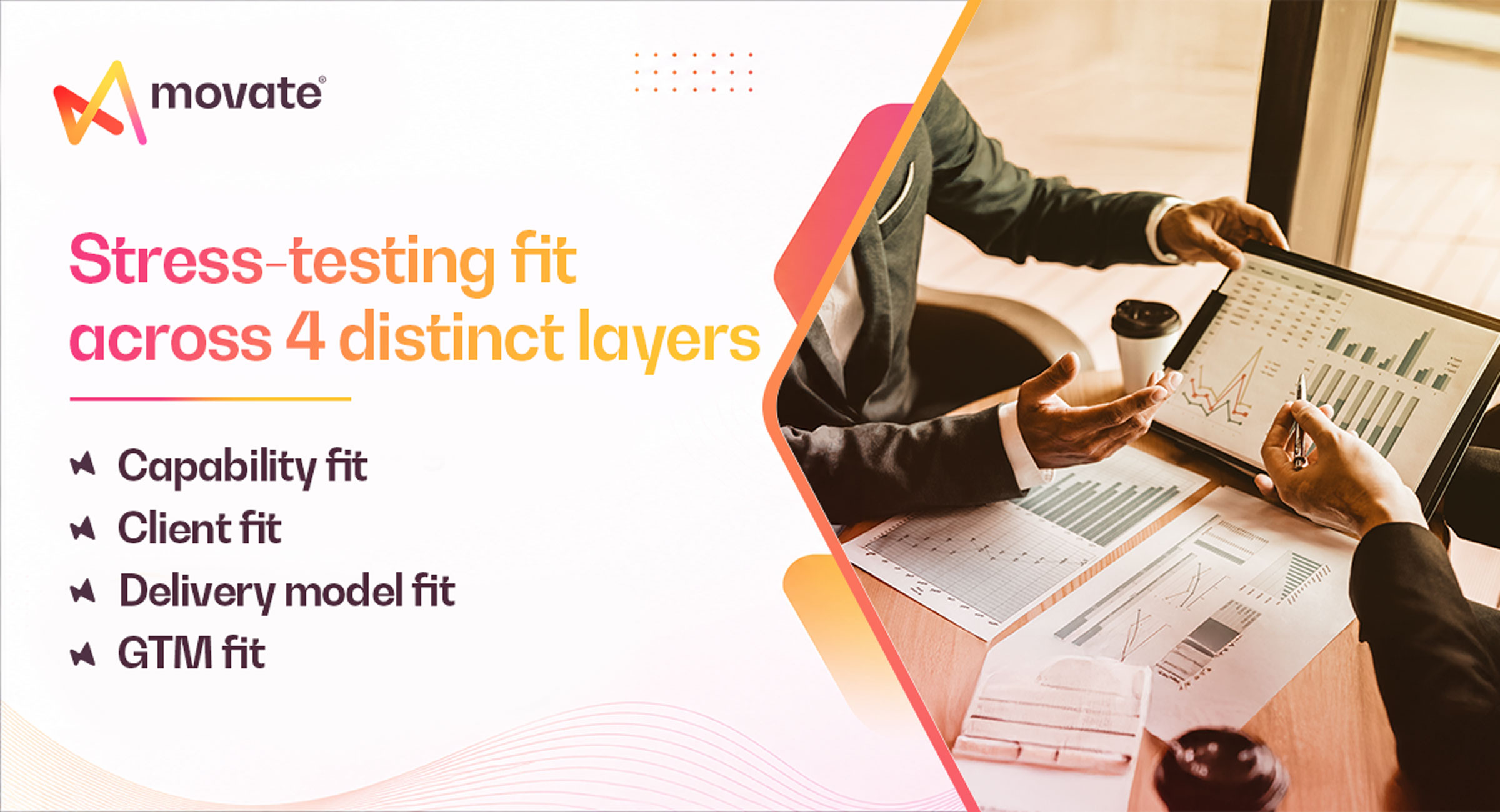
When we evaluate a target, we’re stress-testing fit across at least 4 distinct layers, each of which can independently make or break value creation. These include:
- Capability fit
- Client fit
- Delivery model fit
- GTM fit
Capability fit is the most obvious starting point: does the target fill genuine white space in our portfolio? A new geography, a vertical we’ve been trying to crack, a technology practice we’d otherwise spend 3 years building organically.
This is where most strategic rationales begin and, unfortunately, where many of them also end. Capability fit is necessary but not sufficient.
Client fit is where the picture gets more nuanced. Logo overlap isn’t inherently bad, but it demands a clear answer to a pointed question: is the overlap a cross-sell opportunity or a consolidation risk?
High client concentration on the target side, or significant wallet-share though not necessarily a bad thing may turn a revenue synergy story into a revenue attrition story faster than most integration plans anticipate.
Delivery model fit is the layer that gets underweighted most consistently. Pyramid structures, onshore-offshore ratios, attrition profiles, bench utilization. These aren’t operational footnotes.
They define the economics of the combined entity. A mid-market AI-led IT services acquirer absorbing a high-touch digital consulting firm with a flat, senior-heavy structure isn’t just integrating two companies; it’s trying to reconcile two fundamentally different operating models, and that tension surfaces in margin, in client satisfaction, and eventually in talent retention.
Go-to-market fit is the 4th layer and perhaps the most underestimated.
- Hunter versus farmer sales cultures;
- T&M versus outcome-based pricing; and,
- Partner ecosystem alignment.
When two GTM motions are misaligned, revenue synergies (already the most optimistic line in any synergy mode) become even harder to realize.
Strategic fit vis-à-vis a synergy narrative
A strategic fit is not the same as a synergy narrative; this distinction matters more than most acquirers acknowledge. Synergy models in tech services are frequently reverse-engineered. They are built to justify a price that’s already been anchored in competitive tension, not derived from first principles.
The revenue synergy line in particular deserves scrutiny. Cross-sell between legacy client relationships requires trust between sales teams that, in my experience, takes 18 to 24 months to meaningfully develop. That’s not pessimism, butjust the reality of how enterprise relationships work.
True strategic fit asks a harder question: does this deal make us competitively harder to beat 3 years from now? (Not just larger. Not just more diversified)Genuinely harder to displace. That framing changes what you prioritize in diligence, what you’re willing to pay, and what you’re not.
People are your asset
In AI-led tech services, this dimension has no parallel in other industries. You can acquire the brand, the client contracts, the delivery infrastructure and still lose the deal’s core value within 12 months if the people leave.
And in an ‘acquire-hire-heavy market’, that’s not a hypothetical risk. It’s a base case you have to actively engineer against; Human capital is your asset
Tough questions, honest answers
We need to ask the tough questions and be honest about it. What bothers me isn’t the retention bonus as that’s table stakes. What concerns me is whether the target’s senior talent sees a credible career path inside the combined organization. Whether the projects they’ll work on post-close match the calibre of what they were doing independently. Whether the acquiring brand enhances or diminishes their market standing.
These are questions that don’t surface in financial due diligence. They surface in the conversations you have with leadership before you’re deep in exclusivity and in how honestly the target’s founders answer them.
For founders considering a strategic exit, this is worth reflecting on from the other side. The acquirer who asks these questions early (who treats talent continuity as a strategic variable rather than an HR workstream) is signalling something important about how they think about the business they’re buying.
Closing Thoughts
The best deals I’ve seen get done weren’t the ones with the cleanest models. They were the ones where both sides had done the harder work of understanding fit before the process got competitive.
Where the strategic logic was stress-tested across multiple dimensions, not just the one that made the headline valuation defensible.
If you’re on the buy side, the question worth asking before you’re deep in diligence isn’t “can we justify the price?” The question is: “does the ‘fit stack’ actually hold?”
That’s the question that separates transactions that close from being just transactions to the ones that create value/outcomes for the c-suite

About the Author
Sunil Gujjar, CPA, is the Vice President and Head of M&A at Movate, where he focuses on identifying and executing acquisitions that support the company’s growth and innovation journey. His work goes beyond just closing deals—he’s deeply involved in evaluating opportunities, running due diligence, building financial models, and ensuring smooth integration so that each acquisition actually delivers value over time.
With a CPA and an MBA in Finance, he brings a practical, well-rounded approach to M&A that’s grounded in numbers, but equally focused on long-term business impact. The magic mix of finance + strategy + technology makes his profile compelling.
Prior to Movate, he reshaped the M&A function from the ground up for Happiest Minds Technologies. Sunil worked closely with leadership to build pipelines, define evaluation frameworks, and identify strategic opportunities for inorganic growth; He drove investor relations for Mindtree, acting as a bridge between the company and the investment community. These factors now complement his deal-making perspective in today’s AI era. LinkedIn.
Related Information
Blog: The AI Due Diligence Playbook for Technology Services M&A – Part 1 – Movate