
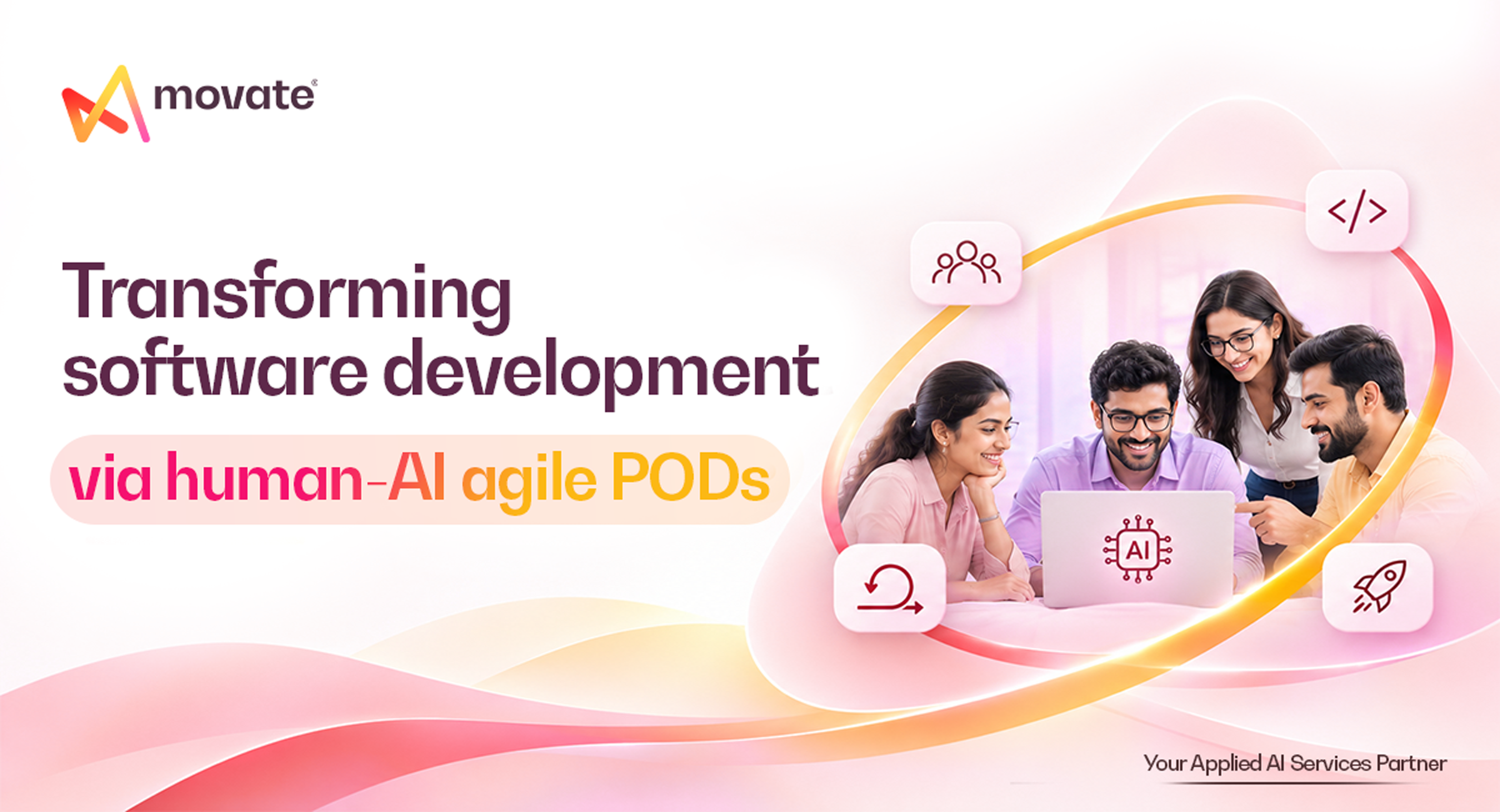
Agile delivery promised speed, adaptability, and continuous improvement. Yet as software products grow more complex, many teams are losing valuable time to coordination, documentation, routine reviews, and administrative work. Human-AI Agile PODs offer a different path: place specialized AI agents inside the team so people can reclaim roughly 30 hours per sprint for higher value work.
Read the full POV by Devanathan Desikan, AVP & AI Architect – Digital Services at Movate.
The hidden crisis inside software teams
Software teams are surrounded by work that is necessary but rarely differentiating. Developers prepare tickets, search for past decisions, update documentation, review predictable changes, and move information between tools. Product owners can spend more time maintaining workflows than speaking with customers. QA specialists often enter too late, after defects have already become expensive to fix.
Routine and administrative activity can consume 60 to 75 percent of a developer’s time, leaving only 25 to 40 percent for architecture, strategic thinking, and creative problem-solving. These figures will vary by team; the underlying issue is widely recognizable. AI acts as an amplifier of the surrounding organizational system, which means fragmented processes and weak feedback loops can limit its value.
This is not simply a productivity concern. Repetitive work can drain experienced engineers. Junior developers may struggle when guidance and codebase context are slow to arrive. The result is a difficult combination: burned-out teams, delayed releases, and less time for innovation.
Human AI Agile PODs redefine team productivity
A Human-AI Agile POD is not a conventional team with a coding assistant added on top. It is a redesigned delivery unit in which people and specialized AI agents work together across planning, development, quality, knowledge, and coordination.
The model assigns agents four practical responsibilities:
1. Role assistants support product owners, developers, and QA specialists by preparing drafts, summarizing context, and answering routine questions.
2. Task agents perform defined activities such as test generation, code review, and documentation.
3. Knowledge services maintain a living memory of the codebase, past decisions, and recurring team patterns.
4. Coordination capabilities route work, monitor workflows, and bring people into decisions that require judgment.
The point is not to replace/reproduce every human role with AI; it’s about redesigning team structures to harness the strengths of both. Product owners can move from administration toward strategy. Senior developers can concentrate on architecture and difficult tradeoffs. QA leaders can shape quality throughout the sprint. Junior developers can get faster access to relevant context.
Human accountability remains essential. The National Institute of Standards and Technology recommends that AI-generated changes pass through human validation, traceability, peer review, security checks, automated testing, and approval workflows. Speed only becomes useful when teams can trust what they release.
How the transformation works in practice
The ’30 hour sprint’ describes capacity returned to people, not a longer sprint. For example, an eight-person POD works across a two-week sprint. By shifting repeatable tasks to AI agents, each team member regains about 20 to 35 hours. That adds up to roughly 268 hours of strategic capacity across the POD.
The same model shows toil falling from nearly 60 percent, sprint velocity moving from about 40 to 60 or 65 story points, and production defects declining by more than half. It also estimates about $1.16 million in annual value from a $100,000 investment, or approximately 9.5 times return on investment. These are modeled outcomes, not universal benchmarks. Actual results will depend on codebase health, engineering maturity, governance, adoption, and the tasks assigned to agents.
That is why a measured rollout matters. Start with one bounded workflow. Record cycle time, review time, rework, escaped defects, delivery stability, and team satisfaction. Give every agent a clear purpose, access boundary, and escalation path. Then compare results across several sprints. Story points alone cannot show whether the team is becoming healthier or the software more dependable.
From faster sprints to smarter teams
In conclusion, agile was never meant to be a collection of ceremonies. Its principles emphasize working software, sustainable development, technical excellence, and regular reflection. Human AI Agile PODs can restore that intent by giving teams more time to think, learn, and solve the right problems.
The lasting advantage will not come from owning the most AI tools. It will come from designing a team in which machine scale supports human judgment. Movate applies this approach through Mova iO Pods, connecting agent capabilities with senior engineering oversight and measurable outcomes. The same human plus AI principle can also bring engineering work closer to CX priorities.
The 30-hour sprint is ultimately about efficient work, not simply more work.
Contact Movate to explore where a Human AI Agile POD can reclaim capacity and improve software delivery.
Frequently asked questions
It is the strategic capacity a team member may regain during a sprint when AI agents take on suitable repetitive and preparatory work.
No. They support defined tasks while developers retain architecture, judgment, review, and accountability.
Common examples include test generation, documentation, routine code review, context retrieval, and workflow coordination.
Track cycle time, quality, rework, delivery stability, team satisfaction, and customer outcomes before and after adoption.
No. They are modeled outcomes from an illustrative POD scenario. Results depend on the team, technology, controls, and implementation quality.
Related Movate resources
- The 30 hour sprint: Human AI Agile PODs
- Mova iO Pods
- Mova iO Engineering
- Artificial intelligence services
References
- Manifesto for agile software development.
- Google Cloud. (2025). State of AI assisted software development 2025.
- National Institute of Standards and Technology. (2026). The role of AI in software development.