
How Movate designed and delivered an Agentic AI onboarding platform for the largest restaurant commerce and SaaS platform in the United States, cutting store onboarding time by more than 70% and eliminating over $1M in annual SLA-penalty losses.

Client Overview
The client is the largest restaurant commerce and technology platform in the United States, a publicly recognized, enterprise-scale Software-as-a-Service (SaaS) provider that powers digital ordering, delivery management, payment processing, and guest engagement for hundreds of national restaurant brands. Its platform supports tens of thousands of restaurant locations nationwide and processes roughly one in six restaurant transactions in the U.S., representing tens of billions of dollars in annual transaction volume. Given the sensitivity of this engagement, the client’s name has been withheld at their request; throughout this story it is referred to as “the Client.”
The Challenge
The Client’s growth depends on a single foundational process: onboarding new restaurant brands and their individual store locations onto its platform. Every store’s menu configuration, point-of-sale integration, payment setup, and brand-specific customization had to pass through this pipeline before the location could go live.
That pipeline was entirely manual. Store creation, system customization, server configuration, and activation were each performed by hand, and requirement-gathering ran through repeated back-and-forth over Google Docs. In the post-pandemic surge in restaurant digital-ordering demand, the volume of onboarding requests grew faster than the Client’s operations team could absorb.
- Brand onboarding averaged 6 months from request to go-live.
- Store onboarding averaged 15–17 days in the best case, and regularly stretched to 30–35 days, a timeline that had to be multiplied across brands with, on average, 250 outlets each.
- A fully manual audit and validation process created high error rates and became a scheduling bottleneck of its own.
- Google Docs-based requirement capture offered no reliable versioning or audit trail, creating exposure against SOC 2 compliance requirements.
- Missed onboarding SLAs triggered regular escalations from store and franchise owners, plus contractual financial penalties, totaling over $1.2 million in losses annually.
Because the platform underpins a significant share of digital ordering for the U.S. restaurant industry, the onboarding bottleneck was not just an internal inefficiency. It constrained how quickly the Client’s restaurant-brand customers could open new locations and generate revenue.
The Solution
Movate served as the Client’s solution partner, with a Movate Enterprise Solution Architect engaged as sole architect for the engagement, directing a cross-functional team of 13 specialists drawn from both organizations. The team designed and delivered an Agentic AI-based, fully automated onboarding platform built around five pillars:
- Agentic AI-driven store onboarding, replacing manual store creation, configuration, and activation with autonomous processing.
- A self-service web application that captures brand customization requirements up front, eliminating the manual back-and-forth that had driven delays.
- An automated audit and validation layer that replaced the lengthy manual review process.
- SLA tracking with automated notifications, so at-risk requests surface before they breach.
- A built-in security and document-versioning framework that gave the onboarding process a full audit trail, closing the SOC 2 compliance gap left by the Google Docs-based process.
Technical Approach
The platform was built as a set of purpose-built Agentic AI agents, each responsible for a discrete stage of the onboarding workflow, orchestrated end to end rather than deployed as a single monolithic bot:
- Self-service front end: a responsive ReactJS/AngularJS web application, deployed on AWS Amplify, replaced the Google Docs-based intake process and gave restaurant brands a guided, validated form instead of an unstructured document.
- Onboarding orchestration agent: an autonomous agent drives store creation, profile configuration, and system activation directly against the Client’s backend, handling the steps that onboarding staff previously performed by hand.
- Intake validation: POS provider details and merchant account numbers, the leading source of onboarding errors and partner outages, are captured and validated automatically at the point of intake rather than checked after the fact.
- Automated audit agent: a continuous, always-on Agentic AI audit layer replaced the periodic manual review, checking configuration and compliance data in real time instead of on a scheduling queue.
- Human-in-the-loop escalation: cases the AI cannot resolve confidently, such as an unrecognized POS configuration or a billing mismatch, are routed to a human reviewer instead of stalling in a queue, so the system automates the volume while preserving human judgment for exceptions.
- Workflow and SLA integration: the platform integrates with the Client’s existing Zendesk environment to create and update work items automatically, track SLA timers, and trigger reminders before a request is at risk of breaching.
- Compliance and audit trail: every configuration change, approval, and document version is logged automatically, giving the Client’s compliance team a traceable, SOC 2-aligned audit trail in place of manual document tracking.
Implementation Timeline
The solution was delivered in two phases, executed in parallel to compress the overall schedule:
- Phase 1: Agentic AI-based automated onboarding engine, 18 weeks.
- Phase 2: Custom content management solution enabling store-level customization without IT involvement, 14 weeks.
Running the two phases in parallel brought the full solution live in seven months, from April 2025 through the second week of November 2025.
The Results
The platform’s impact was measurable across operations, cost, risk, and compliance:
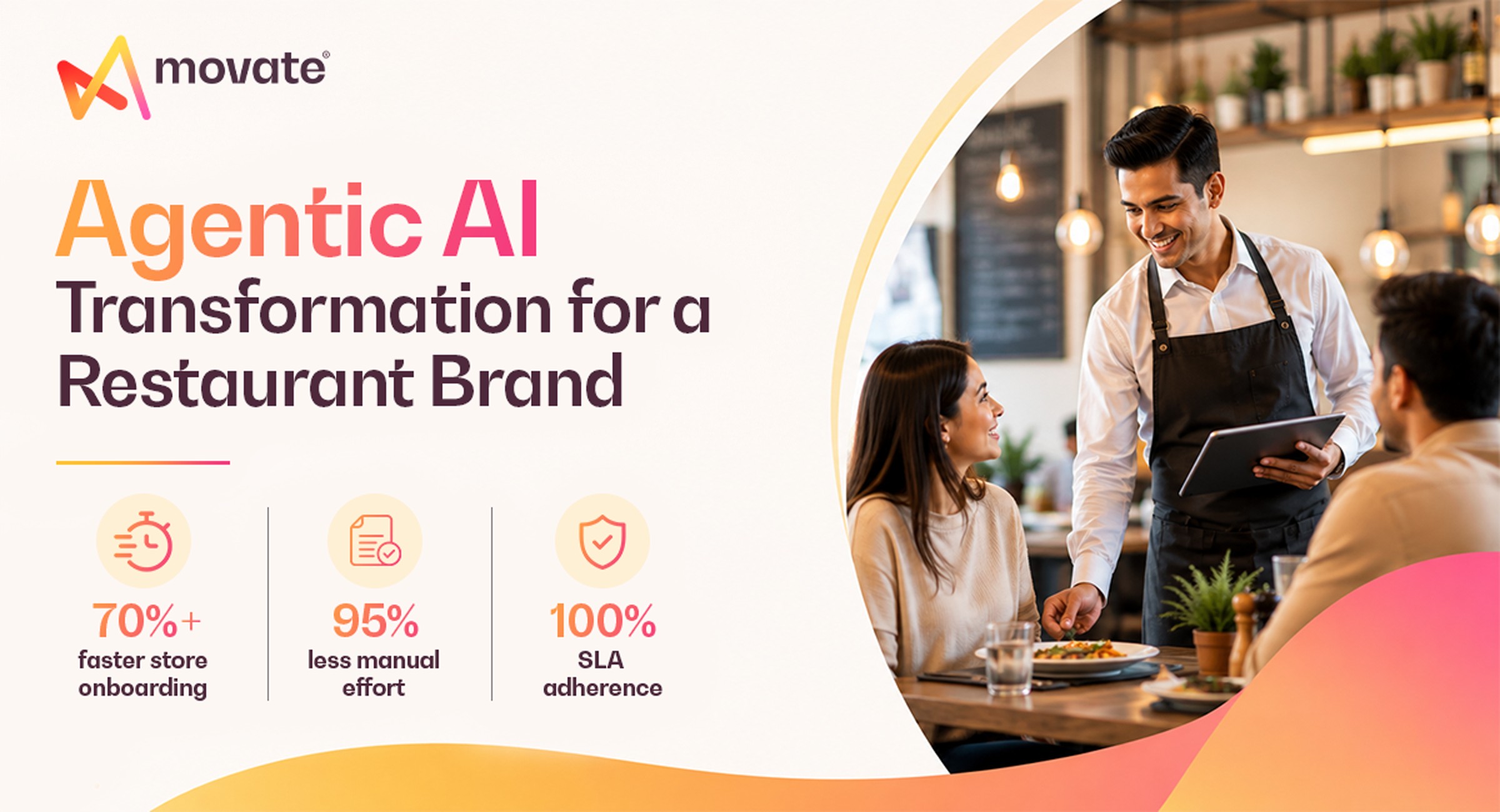
- Store onboarding time fell from an average of 15–17 days (and frequently 30–35) to just 2 days, a reduction of more than 70% in end-to-end cycle time.
- The Agentic AI system eliminated over 95% of the manual work previously required per store onboarding, enabling near-instant processing of requests.
- Manual error rates dropped by more than 90%, removing the rework cycles that had been driving timeline overruns.
- The platform achieved and sustained 100% SLA adherence post-launch, eliminating the $1.2M+ in annual SLA-penalty losses and delivering over $1 million in direct annual savings.
- Broader operational cost savings from reduced manual labor and rework added a further 30–40% reduction in onboarding operating costs.
- 60–65% of the existing onboarding team was repurposed toward higher-value work, with zero workforce reduction and zero operational disruption during the transition.
- The prior process was capped by headcount and could not run onboarding in parallel across brands or stores. The new platform supports unlimited simultaneous processing, eliminating onboarding queues and backlogs entirely.
- The automated audit and version-control framework brought onboarding operations into full alignment with SOC 2 compliance requirements, with zero compliance incidents since deployment.
Broader Impact
Because the Client’s platform processes roughly one in six restaurant transactions in the United States, resolving its onboarding bottleneck had implications well beyond a single internal process. The new platform gave the Client the ability to scale onboarding capacity in step with market demand, supporting the continued digital-commerce growth of the national restaurant brands, franchises, and hospitality businesses that depend on its infrastructure, without the resourcing constraints that had previously capped how quickly new locations could go live.
The architectural approach, applying Agentic AI to a multi-step, compliance-sensitive enterprise onboarding workflow, has since become a reference model within Movate, informing similar automation engagements in other client verticals.