


Two years ago, the questions in every enterprise AI review were about hallucination and context. Would the model make things up? Did it know our policies, our systems, our customers? Those questions have not disappeared, but they are increasingly becoming engineering problems with known patterns. Grounding, retrieval, evaluation gates, and a properly built context layer give teams practical ways to manage them.
The problem growing alongside them gets far less attention: prioritization. Which of the hundred plausible use cases deserves to be built, in what order, and on what evidence? Most enterprises still have no working answer. You can see the result in almost any AI program eighteen months in.
The enterprise has sixty-odd agents in various stages of life. About eight are used every week. A dozen were demos that never left the sandbox. Several do roughly the same thing for different teams, each with its own prompts, integrations, and security exposure. Nobody can say what the population costs to run, and nobody owns the decision to switch any of them off.
That is agent bloat. It is a new form of shadow IT, and it arrives faster because the tooling makes it easy. Anyone with a prompt window and a connector can stand up something that looks like an agent in an afternoon. The cost shows up later: in tokens, in integrations that have to be maintained, in audit questions with no good answer, and in a leadership team that has quietly stopped believing the numbers. (I use “agent” broadly here: any AI-enabled workflow or system that performs tasks on behalf of a user or process, with or without human review.)
The fix is upstream. Bloat is a symptom of funding decisions made on enthusiasm, and the cure is a disciplined answer to one question: which use cases deserve to exist?
Why it happens
Three things conspire. First, the marginal cost of starting an agent is close to zero, while the cost of running one well keeps growing: connectors break, models drift, prompts age, and someone has to answer for what it did. Second, demos are persuasive out of proportion to their value. A working prototype shown to a steering committee creates a pressure to fund it that a spreadsheet of returned hours never will. Third, most organizations have no mechanism for saying no, or for saying not yet. Every reasonable idea becomes a project because there is no filter that ranks reasonable ideas against each other.
The result is a portfolio shaped by who asked loudest and who had the best demo, and portfolios built that way do not compound. Each new agent costs about as much as the last one because nothing built for the previous one gets reused. That is the economic warning sign: if the tenth agent costs roughly what the first one did, the organization is scaling maintenance rather than capability.
Value before technology
At Movate, we use a simple rule: every use case earns its build through an economic filter. If it cannot show returned hours, reduced error, or faster cycle time, it does not get built. TRACE is the prioritization framework we use to make that filter explicit across five dimensions.
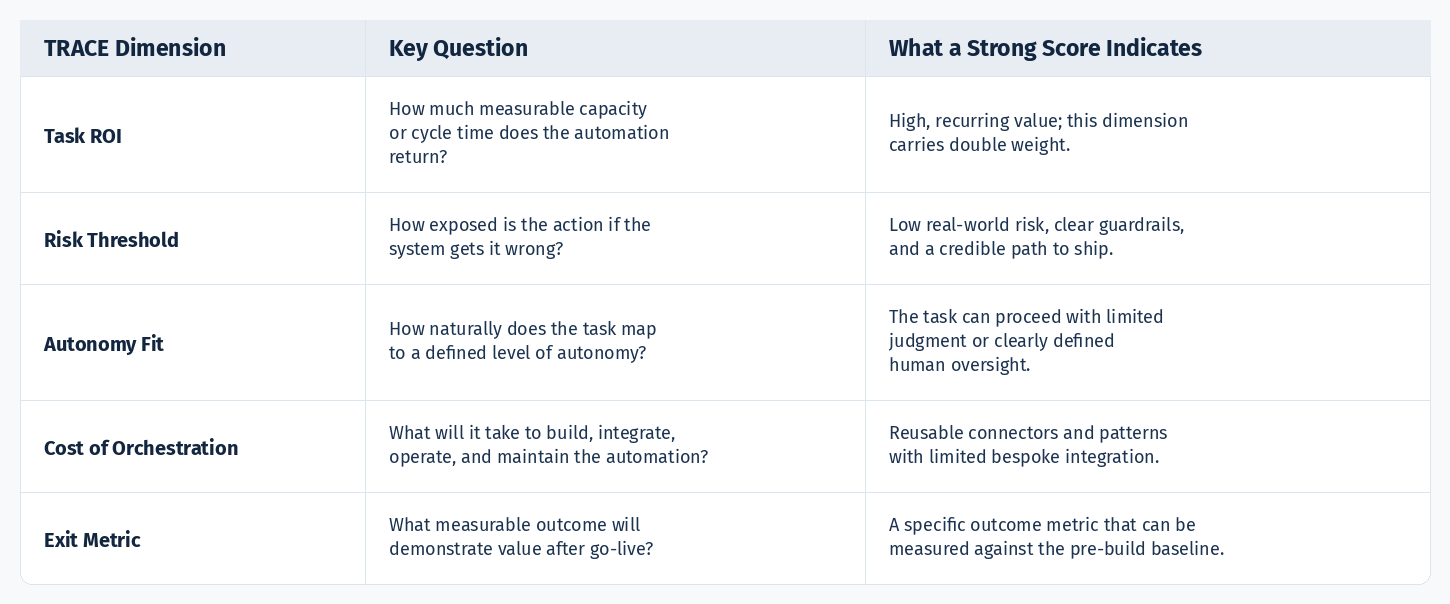
Value combines Task ROI and the exit metric. Feasibility brings together risk, autonomy fit, orchestration cost, and a separate data-readiness check. Multiplying value and feasibility gives a priority score and a wave: first wave, second wave, or queued. The scoring is deliberately blunt. Its job is to force a conversation about hours, evidence, and risk before anyone talks about models.
One rule matter more than the scoring: baseline the current process before you build. Measure how long it takes, how often it goes wrong, and what it costs today. A baseline captured after go-live is a guess, and a finance team will recognize it as one.
The funnel in practice
The numbers tend to be humbling. Consider an illustrative intake of 40 candidate use cases across eight functions. Sixteen drops at the first pass because no one can name an exit metric that would move. Nine more drop on autonomy fit or risk. Six are bespoke builds whose orchestration cost outweighs the return. Nine scores are high enough to fund, and the first wave takes five.
The other 35 are not failures. Most are queued for a later wave with a reason attached, and the reason is the important part. When a sponsor asks why a use case sits in wave two, the answer is a score they can see and a criterion they can argue with.
The highest-value use case is often the wrong one to fund first
This is what separates a real filter from a ranking exercise. If value were the only axis, the first wave could fill with automations that touch consequential work before the required controls are ready. Many of the highest-value opportunities also carry higher operational or governance risk. Prioritization decides two things: what is valuable, and what is ready.
Two examples from the same filter make the point. They involve two of the clearest forms of consequential action: people and money.
In finance, automated invoice approval and payment release scores among the highest on value. It goes to a later wave, because it moves money, which needs segregation of duties, approval thresholds, and audit evidence in place before it acts alone. Invoice data capture and matching, expense receipt checks, and vendor query responses go first.
When a talent acquisition backlog goes through the same scoring, resume screening scores highest of everything on returned hours and still lands in the second wave. It falls into the highest risk tier because it influences an employment decision. It needs bias controls, human review, and evidence that those controls work before it can ship. Interview scheduling, candidate FAQs, and interview-note summarization go first because they are assistive and keep a human in the decision.
A prioritization method that cannot produce that answer is not doing risk work. It is ranking demos.
Keeping the portfolio lean after funding
Choosing well at intake prevents most bloat. Four habits prevent the rest.
Every agent lives in a registry with an owner’s name against it, and if it is not in the registry, it does not run. The registry is how you know what the population is, what it costs, and who answers each entry. It is also one of the first things a security review will ask for.
Reuse before rebuilding. The enterprise context layer, connectors, and approved patterns are built once and inherited by every agent that follows.
Run a quarterly health review for everything in production, with three honest outcomes: keep, refactor, or retire. Weekly active users per agent is one useful signal among several. Read adoption alongside realized business value, transaction volume, reliability, operating cost, and risk. An agent nobody uses without a clear business reason is a cost with a security surface attached, and retiring it counts as a success.
Consolidate overlap on sight. Three functions, each running their own summarize-this-document agent should become one capability with three entitlements. The functions keep their outcome, and the enterprise stops paying three times for one capability.
What a healthy portfolio looks like
A healthy portfolio has fewer agents than the organization could build. Everyone has a baseline, an exit metric, and an owner. The first wave is deliberately boring because low-risk automations with clean metrics are what build the credibility to fund more consequential use cases later. Leadership also has a standing answer to the question it will eventually ask: what did all of this return?
The next phase of enterprise AI will be defined by how clearly an organization can decide which agents deserve to exist, according to evidence, and by how much cheaper, safer, and faster each next one becomes because of what was built before. That decision discipline sits at the center of Movate’s Enterprise AI Adoption Playbook: decide what deserves to exist before deciding how to build it.
About the author

Devanathan Desikan (Deva) serves as VP & AI Architect – Digital Services at Movate, where he leads AI-driven offerings for the software delivery lifecycle, delivering impactful AI and engineering interventions. With over 21 years of experience in strategic positions across key IT functions, he has driven capabilities and solutions in Enterprise AI, software and quality engineering, data & analytics, and product management for AI-led platforms and solutions, as well as global technology office initiatives. Deva holds several patents for his innovations in AI