


The Accessibility Gap Hiding in Your Documents
Healthcare organizations have spent years making their websites accessible. Meanwhile, the documents patients depend onconsent forms, discharge summaries, EOBs emain locked to anyone using a screen reader. Here is why manual remediation will never close that gap, and how an AI-driven accessibility operation does.
There has been a considerable amount of investment by health care organizations towards the accessibility of their website and digital platform. However, there is one major challenge to the accessibility that most healthcare organizations overlook: the thousands of documents that patients need on daily basis.
From consent forms to discharge summaries, EOBs to insurance documents, patient educational material to clinical reports – all these documents are essential parts of patient’s journey. Unfortunately, most of these documents are inaccessible to people using assistive technology like screen readers.
However, this is not a small problem but a large one since more than 70 million adults in US have some kind of disability which makes accessibility of healthcare information a crucial part of equal treatment. Currently, 95.9% of web pages are failing WCAG check and if it’s hard for organizations to make a few hundred web pages accessible, then what about accessibility of millions of documents?
| 70M+ U.S. adults living with a disability | 95.9% of web pages fail WCAG checks | ~75% of remediation effort AI can automate | 3× faster to compliance vs. manual |
| The compliance clock has already started Under the HHS Section 504 rule, healthcare organizations receiving Medicare, Medicaid, or other HHS funding faced their first web and document accessibility compliance deadline on 11 May 2026 and HHS did not adopt the year-long extension that the Department of Justice granted for ADA Title II (now April 2027 for large public entities). For most healthcare providers, this is no longer a deadline to prepare for. It is one to catch up to. |
Accessibility has shifted from a regulatory obligation to a strategic business priority. The question is no longer whether organizations need to become compliant; it’s how they can build a sustainable accessibility program that keeps pace with growing document volumes.
Accessibility Isn’t a One-Time Project
Healthcare organizations create and distribute thousands of new documents every day. Clinical reports, consent forms, enrolment packets, patient communications, and administrative records are constantly being updated across multiple departments.
Traditional accessibility initiatives rely heavily on manual remediation. Teams identify inaccessible documents, fix them individually, validate compliance, and repeat the process whenever new content is published. While effective for smaller document volumes, this approach quickly becomes expensive, time-consuming, and difficult to sustain at enterprise scale.
The result is a recurring cycle of accessibility debt. Organizations complete remediation projects only to find themselves facing the same backlog months later.
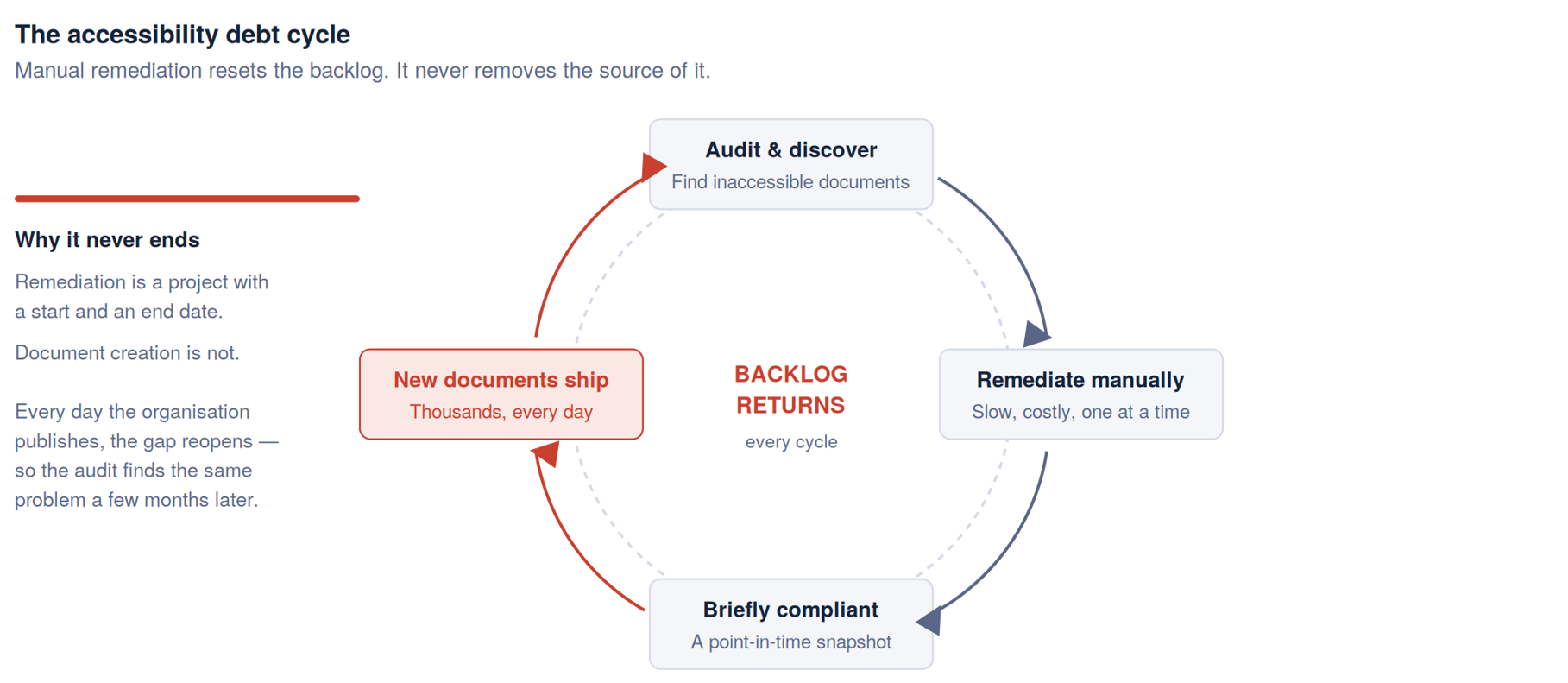
Figure 1 — The accessibility debt cycle. Manual remediation is a project with an end date; document creation has none. The gap reopens the day the project closes.
To keep pace, accessibility must evolve from a reactive project into a continuous operational function embedded throughout the document lifecycle.
AI Is Transforming Accessibility Operations
The adoption of artificial intelligence in healthcare is revolutionizing the approach to accessibility by automating processes that previously took up much time and effort from healthcare organizations.
Today’s state-of-the-art AI-based tools for accessibility can quickly detect inaccessible documents, review their WCAG compliance, pinpoint areas of non-conformity, restructure the document, optimize reading order, produce alt text, add relevant metadata, and validate the document accessibility within thousands of documents at once.
While automation provides speed and accuracy, accessibility requires more than just meeting compliance standards. Documents used in healthcare are typically characterized by the presence of sophisticated tables, images, specific terminology, and structured forms that need a judgement call.
In this regard, an accessibility expert plays an indispensable role, as they can verify complex content and make sure that it is not only accessible but also useful for people with disabilities.
The real transformation happens when AI and human expertise work together: AI handles repetitive remediation at scale, while specialists focus on the complex reviews that require context and accessibility expertise.
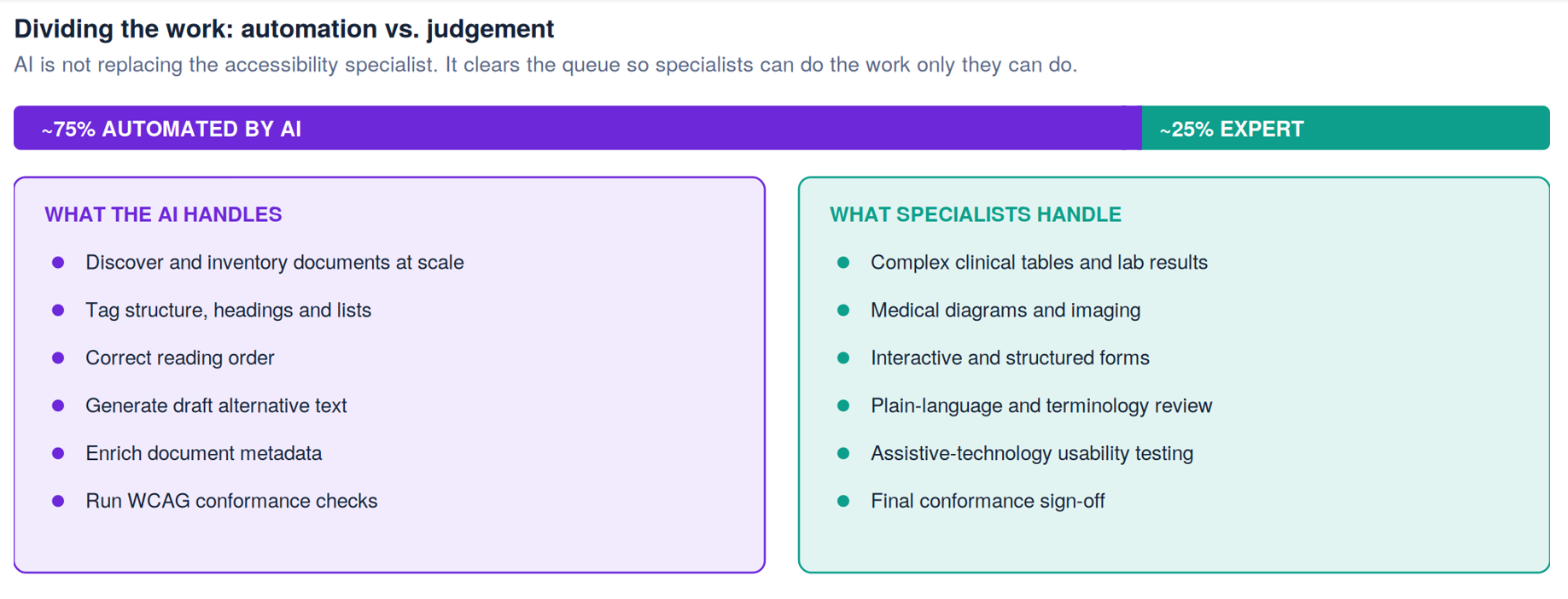
Figure 2 — Dividing the work. Automation absorbs the volume; specialists retain the judgement calls that determine whether a document is genuinely usable.
From Remediation to Accessibility Operations
Forward-looking healthcare organizations are moving beyond periodic remediation projects toward continuous accessibility operations.
Instead of the traditional, “How do we make our current documents compliant?” they are taking a different perspective and asking, “How do we make sure every single document we create is made accessible right from the get-go?”
These moves transform accessibility from something that happens once a year to a process capability. Documents are identified, analyzed, remediate, validated, published, and monitored as part of a workflow process.
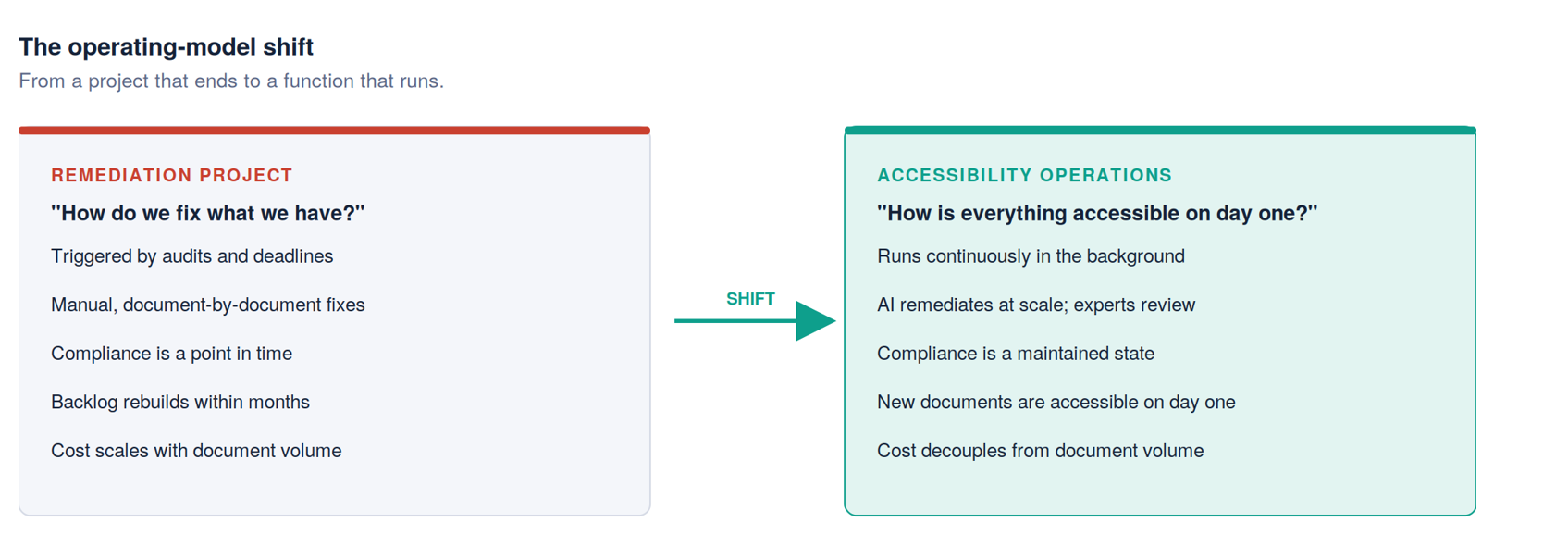
Figure 3 — The operating-model shift. From a project that ends to a function that runs.
How Movate AccessOps Scales Accessibility
This is where Movate AccessOps is helping healthcare organizations modernize accessibility. AccessOps combines AI-powered automation, accessibility specialists, and continuous governance into a managed accessibility operations framework designed specifically for enterprise-scale document ecosystems.
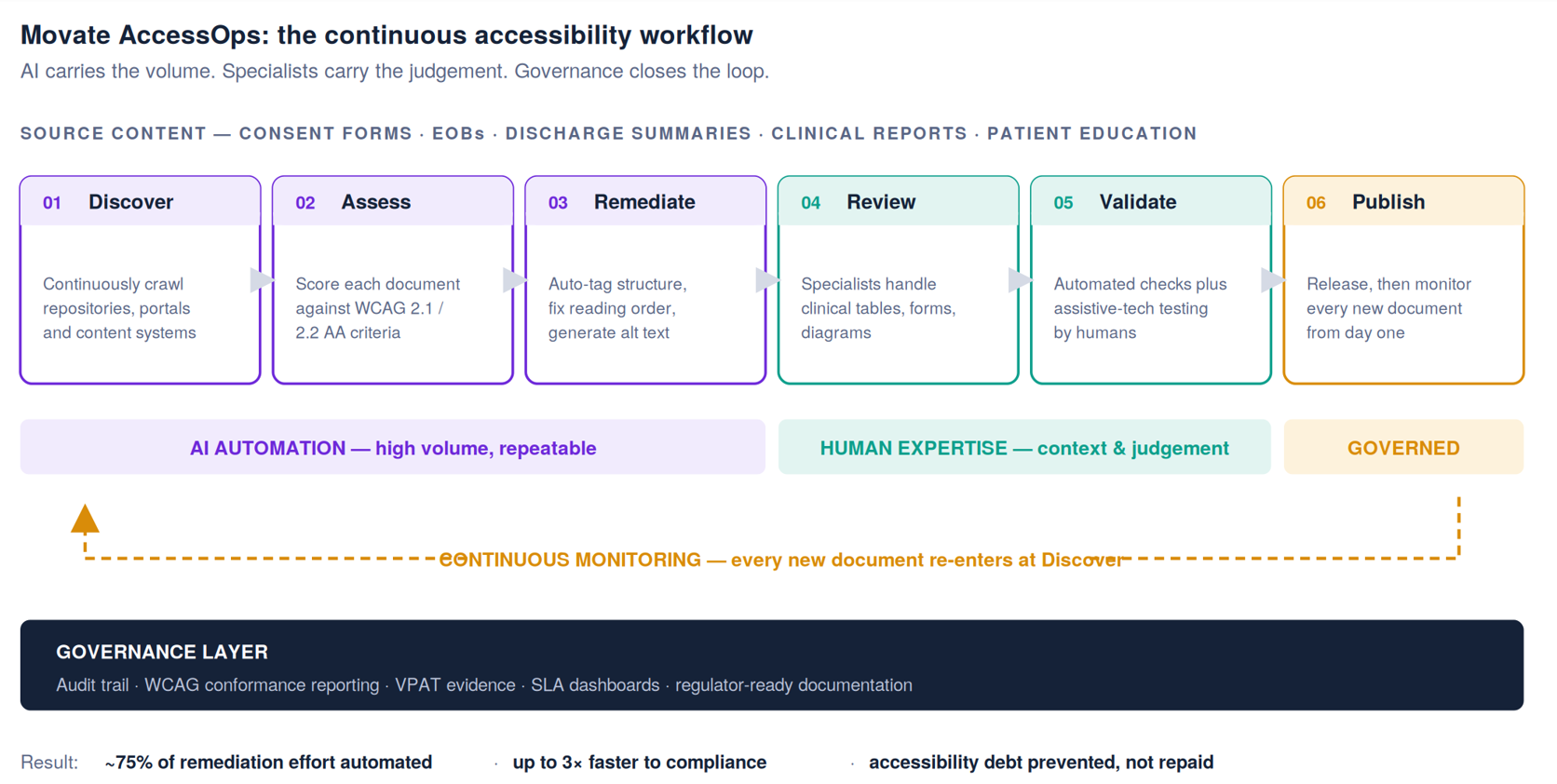
Figure 4 — The AccessOps workflow. AI carries the volume across discovery, assessment and remediation; specialists take over for clinical judgement; governance and continuous monitoring close the loop so new documents never accumulate into debt.
How the workflow runs
- Discover —AccessOps continuously scan document repositories, patient portals, and content systems to build a centralized inventory of digital assets. New and updated documents are automatically detected, ensuring complete visibility.
- Assess — Every document is evaluated against WCAG 2.1 and 2.2 Level AA standards. AI identifies accessibility issues and prioritizes remediation based on their impact on patient access.
- Remediate — AI automates fixes by applying document tags, correcting reading order, generating draft alternative text, and enriching metadata, enabling thousands of documents to be remediated in parallel.
- Review — Accessibility specialists validate complex content, including medical diagrams, clinical tables, forms, and specialized terminology, ensuring accuracy where human expertise is required.
- Validate — Automated accessibility checks are combined with assistive technology testing to ensure documents are both WCAG-compliant and usable for people with disabilities.
- Publish and Monitor — Approved documents are published and continuously monitored. Any new or updated document automatically re-enters the workflow to maintain ongoing accessibility compliance.
| The outcome By automating nearly 75% of document remediation effort, AccessOps significantly reduces manual work and enables organizations to achieve compliance up to 3× faster than traditional manual remediation. Continuous monitoring ensures every newly published document is automatically assessed preventing accessibility debt from accumulating rather than repaying it after the fact. |
Instead of treating accessibility as a one-time initiative, healthcare organizations can establish a scalable operating model that evolves alongside new content, changing regulations, and growing patient expectations.
Accessibility Creates Better Patient Experiences
Although compliance can serve as the initial trigger, accessibility offers much more value.
Accessible healthcare content provides individuals with disabilities with the chance to review treatment options on their own, fill out forms, learn about insurance details, and make decisions regarding their healthcare. This not only reduces the paperwork but also makes patients feel involved in the process and builds trust.
The issue of accessibility is not limited to the requirements for WCAG compliance. This is about providing an inclusive and equitable healthcare experience
The Future of Healthcare Accessibility
As healthcare organizations work through their compliance obligations, success will depend on more than remediating yesterday’s documents. It will require building an intelligent accessibility operation that continuously identifies, remediates, validates, and monitors every new document before it reaches patients.
Organizations that embrace AI-powered accessibility operations today will not only accelerate compliance but also improve operational efficiency, reduce long-term remediation costs, and deliver more inclusive patient experiences.
The future of healthcare accessibility isn’t about checking a compliance box. It’s about ensuring every patient has equal access to the information they need without barriers.
Regulatory note: HHS Section 504 (May 2024 rule) set a first compliance deadline of 11 May 2026 for recipients of HHS funding. The DOJ’s ADA Title II deadlines were extended in April 2026 to 24 April 2027 (large public entities) and 26 April 2028 (smaller entities). HHS did not adopt that extension. Statistics cited: WebAIM Million 2026; U.S. Census / CDC disability prevalence. This article is informational and is not legal advice.
Author

Nilesh Ruparelia is an AVP of Healthcare Sales at Movate with over 20 years of experience driving business growth and digital transformation for healthcare organizations. He partners with healthcare payers, providers, and PBMs to help them adopt AI, cloud, data modernization, analytics, and intelligent automation solutions. At Movate, he focuses on building strategic client relationships, expanding enterprise accounts, and delivering technology-led business outcomes through innovative healthcare solutions.
"*" indicates required fields