


Why the Future of Analytics Isn’t Analytics at All
For more than a decade, organizations have invested heavily in analytics—modern data platforms, dashboards, KPIs, models, and now AI. By most measures, analytics maturity has improved dramatically.
And yet, when real operational decisions must be made—as conditions change and trade-offs emerge—many organizations still hesitate.
When that hesitation appears, the explanation is familiar: “The data isn’t decision-ready.” In most data-mature enterprises today, however, this diagnosis only tells part of the story. The real issue is not the absence of analytics. It is the absence of decision enablement. The future of analytics, paradoxically, lies beyond analytics itself.
The paradox leaders are living with
On paper, enterprises are better equipped than ever. Data pipelines are automated. Metrics are standardized. Models are increasingly sophisticated.
Yet decision velocity has not kept pace.
Leaders pause to validate numbers. Teams escalate decisions upward. Actions are delayed or diluted. Despite abundant insight, confidence at the moment decisions are shaped remains fragile.
Industry analysts are beginning to highlight this shift. Gartner predicts that by 2026, 75% of global enterprises will apply decision intelligence practices to log and analyze decisions—reflecting a growing understanding that analytics alone is not enough; organizations must also improve how decisions are made and executed.
This paradox exists because organizations have optimized for producing insights, while business outcomes depend on executing decisions. Analytics answers questions—but answers alone do not guarantee action.
Why dashboards fail at the exact moment decisions matter
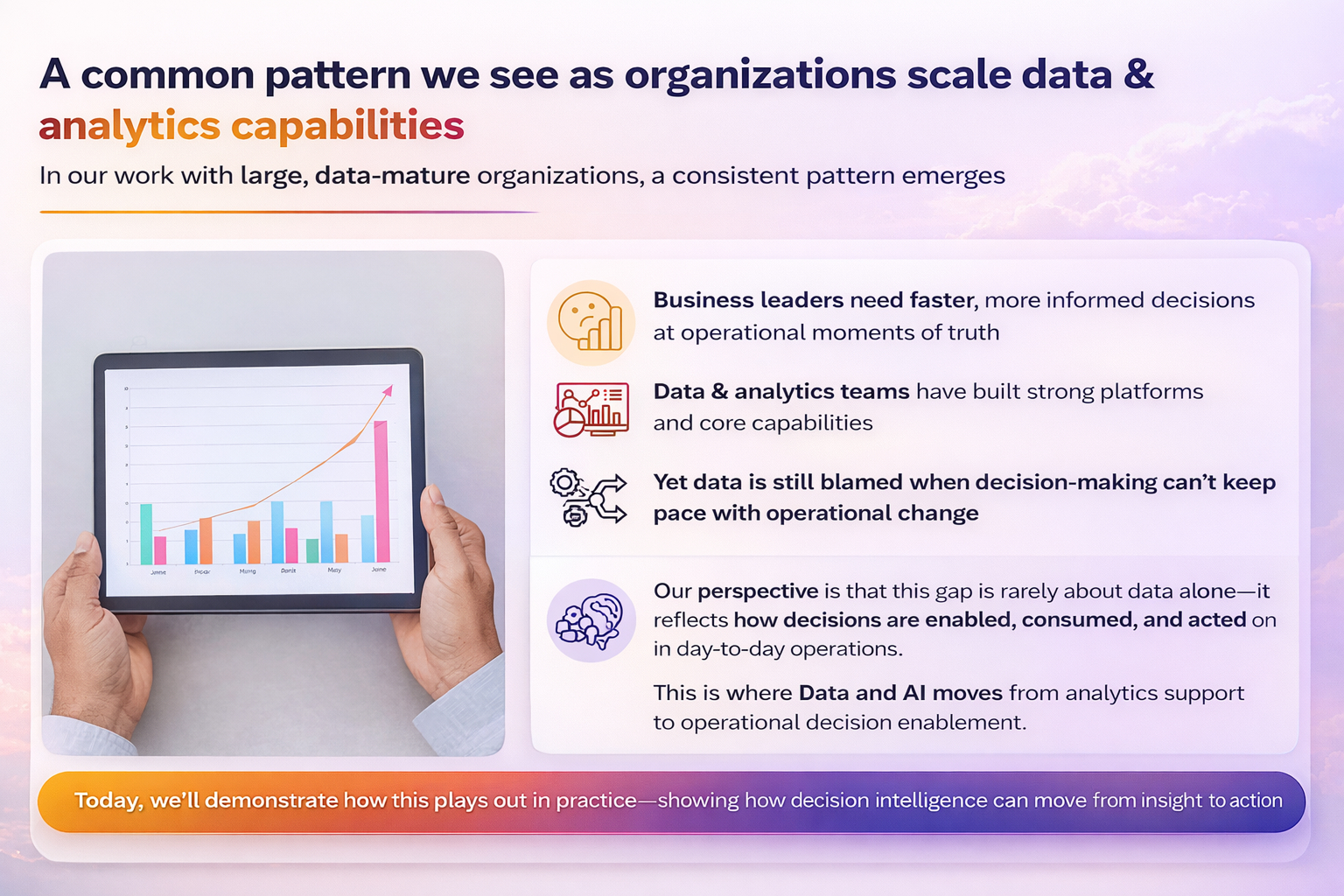
Dashboards and reports remain the dominant interface between data and the business. They are effective for tracking performance and reviewing trends. But they were never designed for decision-making in the flow of work.
Real decisions rarely begin with a metric. They begin with a situation.
An exception appears. A threshold is crossed. Something changes unexpectedly. A leader asks: Why did this happen? What changed? What should we do next?
Dashboards require users to translate these situational questions into filters, dimensions, and views—assuming they know where to look and how to interpret what they see. At decision time, that translation effort becomes the bottleneck.
As situations evolve, teams revert to spreadsheets, email threads, ad-hoc analysis, or instinct. Confidence erodes, escalation increases, and action slows. At that point, analytics gets blamed.
The issue isn’t that dashboards are wrong. It’s that dashboards are built for inspection, not for decision-making as context changes.
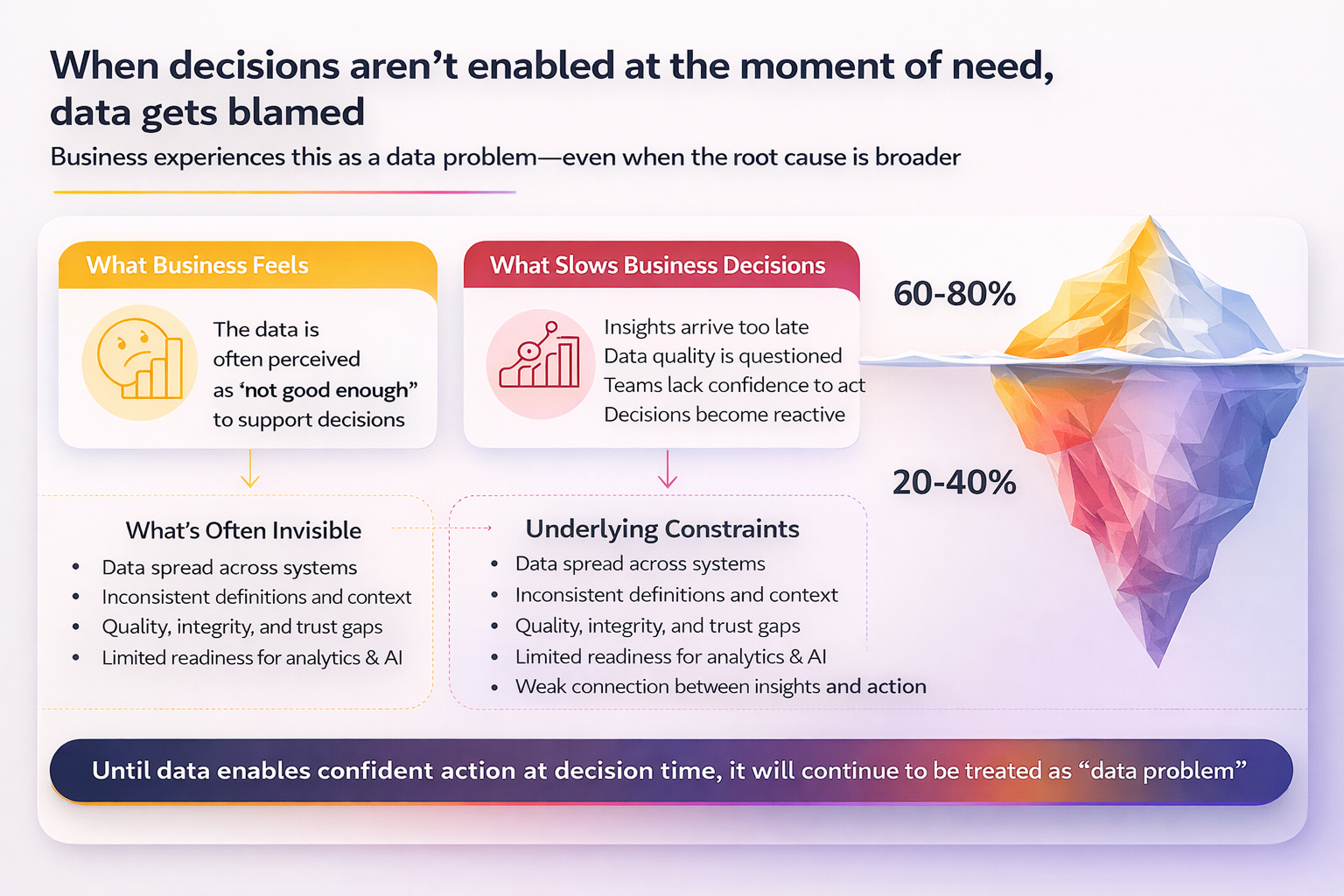
Decision Gap Iceberg
An iceberg-style visual showing what the business experiences on the surface (data quality concerns, delayed insights, lack of confidence in data) versus the deeper underlying issues below the surface (fragmented data across systems, inconsistent definitions, trust gaps, and weak connection between insights and action). The idea is to illustrate how what appears as a “data problem” is often actually a broader decision enablement challenge.
Where decision friction actually comes from
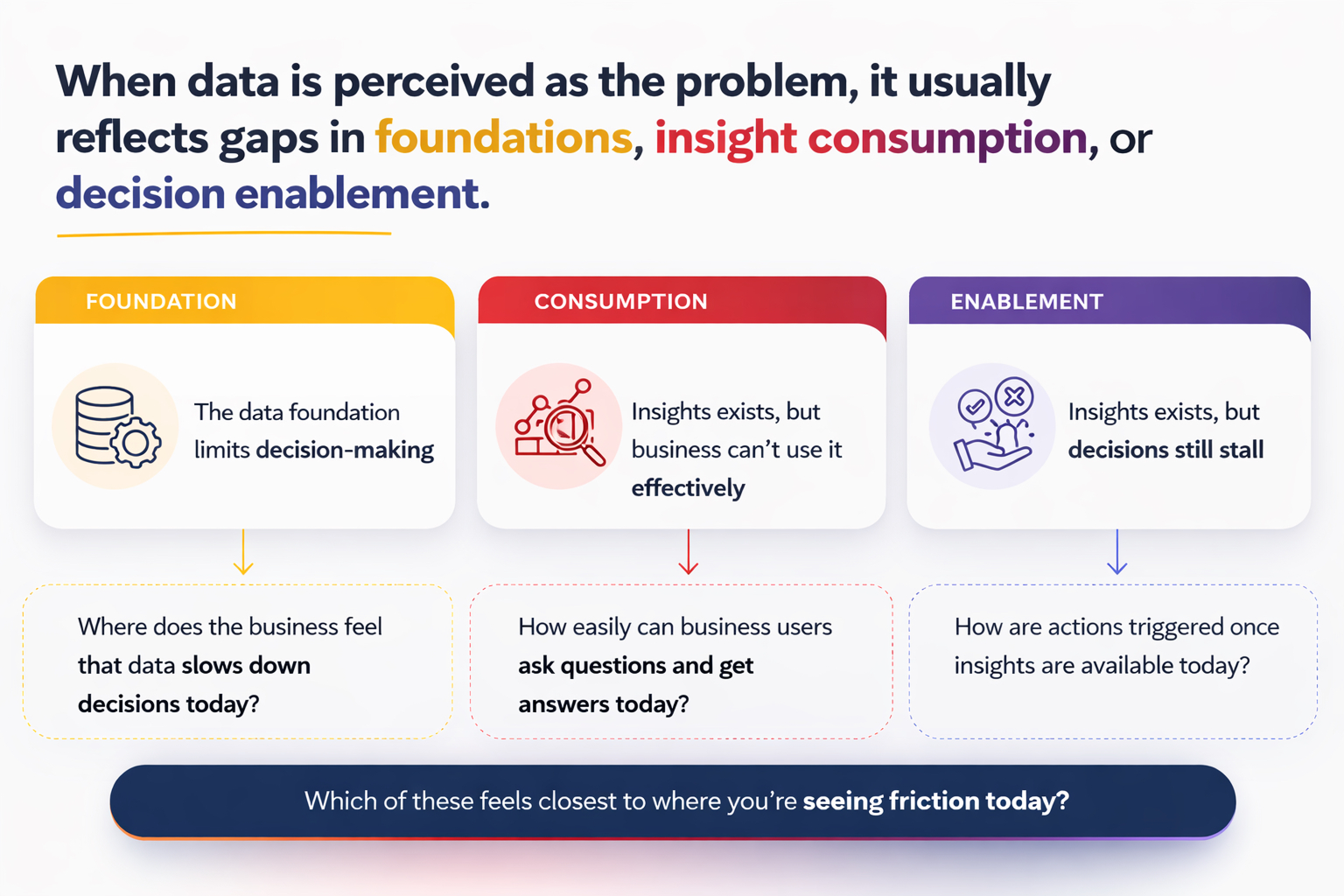
When organizations look beyond surface explanations, decision friction almost always accumulates across three compounding constraints as decisions move from data, to understanding, to action:
- Foundation: when data isn’t decision-ready Data exists, but it is not consistently reliable, contextual, or aligned to how decisions are made. Definitions vary across systems, quality fluctuates as data changes, and important decision context often lives in people’s heads, not in data or systems. In many organizations, trust is still assessed after the fact instead of being continuously reinforced as data flows—making confidence fragile at decision time.
- Insight consumption: when answers aren’t accessible in the moment Dashboards and reports exist, yet business users still struggle to get answers when they need them. Their questions don’t map cleanly to predefined views, analyst support is required, and response times don’t align with decision timelines. Insight latency becomes decision latency.
- Execution: when insight doesn’t translate into action Even when insight is trusted and available, decisions still stall because execution is disconnected from understanding. Turning insight into action requires coordination across tools, teams, and processes. Decision logic is recreated repeatedly, making execution manual, slow, and inconsistent.
As decisions move from data, to understanding, to action, these constraints compound—which is why analytics continues to be questioned even in organizations with strong data foundations.
From Insight to Action Flow
A simple left-to-right flow diagram showing how organizations move from Data Foundation → Insight Consumption → Decision Enablement, highlighting how reliable data, easy access to insights, and AI-assisted decision orchestration work together to turn insights into operational action.
A simple example
Consider a simple scenario.
A regional sales leader notices that demand for a key product has dropped in the Northeast. The dashboard shows the decline but doesn’t explain why, so the leader asks the analytics team to investigate. By the time the drivers become clear, valuable time has already passed.
Now imagine the same moment in a decision-enabled environment.
Instead of navigating dashboards or waiting for analysis, the leader simply asks: “Why did demand drop in the Northeast this week?”
The system immediately surfaces the key drivers—inventory disruption, a pricing change, and a competitor promotion—and recommends the most viable response.
With the right guardrails in place, those actions can be initiated immediately.
Decision enablement means a system doesn’t just answer questions—it recommends actions and initiates execution while the moment to act still exists.
What actually changes the equation
Closing this gap does not start with more dashboards or more sophisticated models. Most organizations already have the answers they need.
What’s missing is support at the exact moments when decisions are formed and carried forward.
First, decisions slow because getting to an answer takes too much effort. In real operating contexts, questions are situational and time-bound: Why now? What’s different? What option best balances risk and opportunity? When leaders must navigate dashboards or wait for analysis, momentum is lost.
This is where natural-language interaction changes the experience. Instead of translating questions into filters and views, people ask the question they actually have, in their own words, in the moment. The system handles interpretation and context, returning an answer that can immediately inform a decision. The value here isn’t novelty—it’s clarity, continuity, and confidence.
But faster answers alone don’t solve the problem.
Many decisions still stall because knowing what’s happening doesn’t automatically lead to action. Execution requires applying policies, weighing trade-offs, coordinating steps, and triggering downstream systems. This is where traditional analytics stops—and where decision ownership becomes fragmented.
Agent-assisted decisioning and action orchestration close this final gap. Decision logic is embedded directly into workflows. Recommendations are evaluated against constraints. Guardrails are enforced consistently. Execution is initiated rather than debated.
Decisions stop being one-off interpretations. They become repeatable, governable flows that move from insight to action without losing momentum.
The real strategic implication
The next frontier of analytics value is not better insight. It is better decisions, executed with greater consistency and confidence.
That requires leaders to rethink where analytics investment goes—from dashboards and reports toward interaction, execution, and decision ownership.
Until data enables confident action—without translation, delay, or manual coordination—it will continue to be questioned.
The organizations that pull ahead will be the ones that stop asking, “Do we have enough analytics?” and start asking, “Who—or what—is actually enabling our decisions?”
At Movate, this perspective increasingly shapes how we work with clients—helping organizations design data, AI, and decision systems that turn insight into confident action.

Aakash Deep Arora is the Vice President – Data Practice at Movate, where he leads the growth of the company’s Data services and works closely with teams to strengthen Movate’s Data, Analytics, and AI capabilities for clients and markets.
With nearly two decades of experience across Data, Analytics, and AI, Aakash specializes in driving business transformation, building scalable data practices, and delivering measurable client outcomes. He has a strong background in consultative selling and solution-led growth, helping organizations unlock high-value, data-driven opportunities.