


In our highly competitive business ecosystem, customer experience has become integral to competitive differentiation, brand loyalty, and revenue growth. The customers of today expect seamless interactions across discovery, purchase, and post-purchase support. At the same time, retailers are experiencing a plethora of new concerns.
As a result, CX investments across retail continue to expand. Enterprises are spending more on omnichannel platforms, digital support, self-service, and customer engagement tools. Yet many retail leaders struggle to answer a fundamental question: what business outcomes are these investments actually delivering?
CX performance may look healthy on dashboards, but conversion rates don’t budge, cart abandonment persists, and loyalty improvements lag behind expectations. This gap highlights a growing reality. Traditional CX engagement models are no longer sufficient in a retail environment where experience directly influences revenue, retention, and lifetime value. This is where outcome-based CX models change the conversation.
Why Traditional CX Models Fall Short for Retail Enterprises
Traditional CX, often primitive for modern ecosystems, are costly and labor-centric, hindering true organizational growth. Pricing is typically tied to inputs such as headcount, hours, or interaction volumes, with performance measured through operational SLAs like response time, handle time, or resolution rates. While these metrics provide structure and predictability, they do not explain whether CX is influencing customer behavior.
In retail, this limitation is especially problematic because CX touches revenue generating moments across the customer journey. And while traditional CX models are not fundamentally flawed, they create limited alignment between retailers and service providers. Success is measured by activity rather than impact, leaving limited incentive to optimize CX in ways that directly influence business growth.
Outcome-based CX addresses this structural gap by redefining how success is measured and rewarded.
The Retail Lens: The Outcome-Based CX Model in Action
Outcome-based CX models shift the focus from inputs to impact. Instead of measuring success by how much work was done, these models define success by what improved for the business. In retail, this shift is critical because CX influences conversion, loyalty, and lifetime value.
So, what exactly does an outcome-based model look like? Here’s a closer look at the key characteristics.
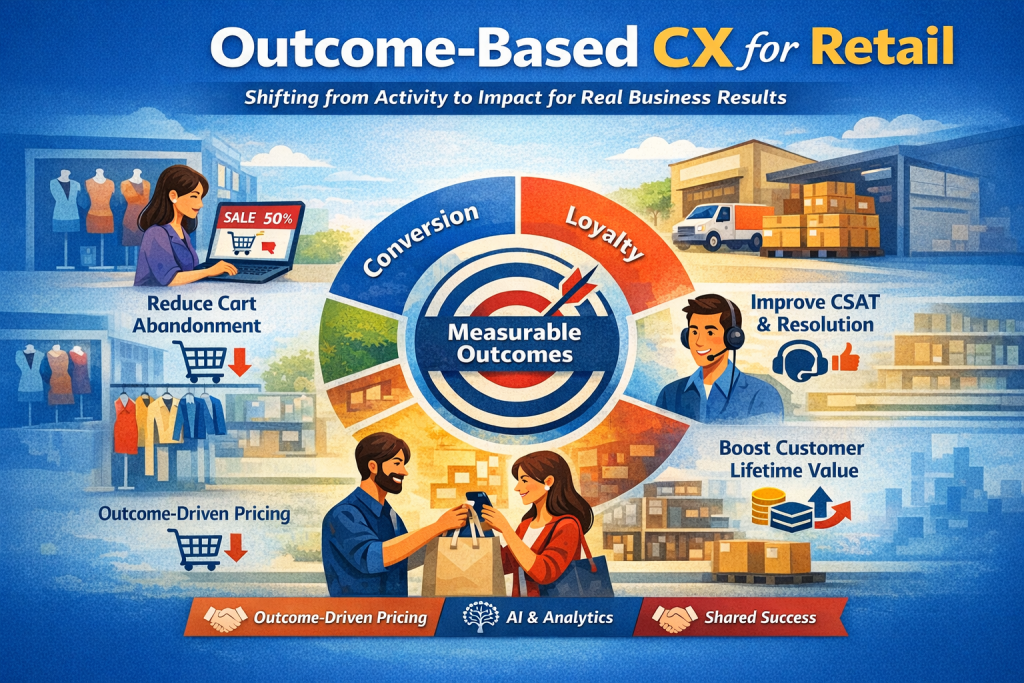
- Defining Retail Outcomes That Matter: Outcome-based CX begins with clarity. Retailers and service providers align on specific business outcomes, define how success will be measured, and structure delivery and pricing around achieving those results. This often includes improving conversion rates across digital channels, reducing cart abandonment, increasing first contact resolution in post purchase support, and driving higher customer lifetime value. Outcomes may also focus on improving CSAT and NPS in ways that correlate with revenue, retention, and repeat purchases.
This can yield positive benefits for retail stakeholders. Procurement teams gain clarity on ROI. Marketing teams see CX as a contributor to brand perception and campaign effectiveness. Sales and ecommerce leaders connect CX improvements directly to revenue. CX leaders move beyond volume management toward experience quality and effectiveness. - Aligning Pricing to Measurable Improvements: In an outcome-based model, pricing is linked to achieving agreed improvements rather than delivering a fixed level of effort. Retailers do not pay simply for coverage. They pay for results that move the business metric needle in a positive direction.
With pricing now directly dependent on business results, a sense of shared ownership is created. Risk and reward are equally shared between the retailer and the service provider, encouraging continuous optimization and a constant push for success. - Application Across the Entire Journey: For the model to function seamlessly and bear fruit, outcome-based CX must be adopted to span the full retail lifecycle. In pre-purchase stages, it improves product discovery, reduces friction, and supports faster decision making, contributing directly to higher conversion. During purchase and fulfillment, it focuses on proactive communication and issue prevention to reduce abandonment and dissatisfaction. In post-purchase support, the emphasis is on faster resolution, fewer repeat contacts, and stronger customer loyalty.
Rather than treating CX as a siloed function, outcome-based models embed CX performance into the broader retail operating rhythm. Every interaction is evaluated through the lens of its contribution to business outcomes.
How Movate Makes Outcome-Based CX Real for Retail
Outcome-based CX requires more than a commercial shift. It demands strong execution, advanced measurement, and the ability to adapt at scale. Movate works with retailers to define outcomes grounded in business priorities, supported by clear baselines and success criteria. These outcomes are meticulously tracked and constant visibility is provided into performance against agreed KPIs, enabling faster and more informed decisions.
Movate also helps retailers overcome challenges associated with adopting the latest technology trends. Analytics and AI connect CX actions directly to business results, whether through improved self service, intelligent deflection, or agent enablement. These capabilities support consistent experiences at scale while improving efficiency and effectiveness.
The Payoff and the Path Forward
When CX partnerships are built around real-world outcomes, retail enterprises gain a clearer picture of the value of their investments. This model also aligns teams across the enterprise. Procurement evaluates CX spend based on impact. Marketing and sales see CX as a contributor to growth. CX teams focus on improving experience quality with measurable outcomes.
With shared accountability and continuous measurement, CX improvement becomes ongoing rather than episodic. And with sophisticated AI-driven capabilities as the backbone, positive results are bound to follow. For retailers navigating rising expectations and competitive pressure, outcome-based CX provides a more accountable and scalable path forward.
When CX partnerships are built on outcomes, every interaction works harder for retail growth. Explore how outcome-based CX can drive measurable retail results at Movate. Speak to us now.
About the author

Siddharth Victor heads the sales and solutions division across Customer Experience Management & Enterprise Support Services at Movate. He has 17 years of experience in the IT industry, all of which has been with Movate. He is responsible for hunting new logos, providing consultative expertise for clients and internal stakeholders, pipeline generation, business and services transformation, identifying and creating forward-looking solutions and developing innovative differentiators in support.