


A major retailer reduces its CX vendor footprint from five partners to three. Procurement declares victory: fewer contracts, clearer accountability, and lower overhead.
Six months later, holiday CX scores dip, chatbot containment stalls, and planned AI pilots are pushed to Q2. Operations are stable, but momentum has slowed.
This is becoming the new norm in retail.
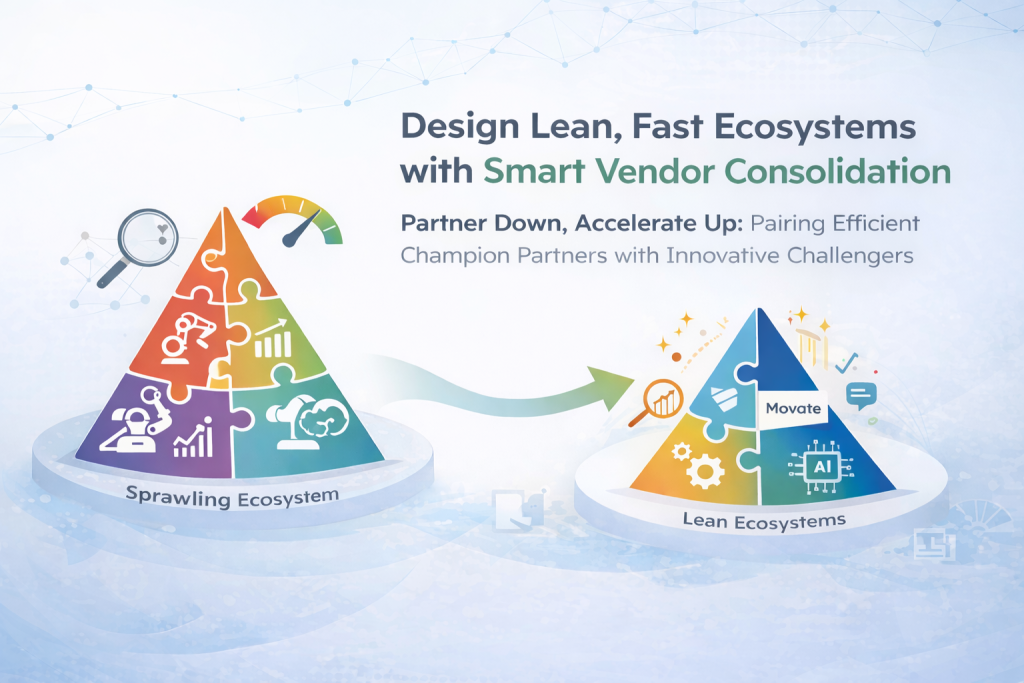
Under pressure to protect margins and simplify operations, most retailers are not moving to a single vendor model. Instead, they are shrinking from sprawling ecosystems of four to six partners down to two or three strategic vendors across CX, IT, automation, and digital.
The logic is sound. A leaner ecosystem should mean less integration complexity, better pricing leverage, and clearer ownership. In theory, consolidation should streamline execution and improve profitability.
In practice, partial consolidation without intentional design often delivers stability, but at the cost of speed and innovation.
Retailers still managing multiple CX, IT, and automation partners continue to wrestle with overlapping tools, redundant workflows, and layered governance. Salesforce’s Total Economic Impact research shows that platform consolidation can unlock significant value, but only when roles, workflows, and innovation ownership are redesigned alongside the technology.
Too often, retailers cut vendors without clearly defining what each remaining partner is responsible for beyond running the business. The result is a cleaner vendor list, but a slower organization.
The real question is no longer whether consolidation saves money. It is whether it is costing momentum.
This is the consolidation paradox, and it is shaping how retail leaders think about their remaining partners.
Why “Lean” Does Not Automatically Mean “Fast”
Reducing from many vendors to few is progress, but it is not a strategy by itself.
When consolidation is treated primarily as a procurement exercise, complexity tends to shift rather than disappear. Integrations remain brittle, ownership stays blurred, and innovation responsibilities become ambiguous.
These weaknesses surface during peak moments. Black Friday outages expose fragile handoffs between systems. BOPIS journeys falter when inventory, order management, and store tools are not fully aligned. Store to digital experiences break when CX platforms, loyalty systems, and mobile apps are loosely stitched together. These failures are not random. They are the predictable byproduct of leaner ecosystems that were not intentionally designed.
At the same time, AI is raising the bar for speed across retail. Conversational AI, agent assist, demand forecasting, and personalization are moving from experiments to core capabilities. By 2026, nearly all retail tools are expected to embed AI, making rapid iteration and scaling a baseline expectation rather than a differentiator.
Here is where many two to three vendor ecosystems get stuck.
With fewer partners, leaders often expect each vendor to do more. But without clearly defined roles, vendors default to protecting their core scope rather than pushing innovation. Roadmaps slow. Change requests take longer. Seasonal staffing flexibility tightens. AI pilots get deprioritized in favor of platform stability.
The ecosystem is simpler, but less agile.
The challenge is not whether consolidation works. It is whether the remaining partners are structured to sustain change.
From Shrinking Vendors to Designing Roles
The answer is not to stop consolidating. It is to be more intentional about how the remaining two or three vendors are positioned.
Rather than asking how many vendors should we have, leading retailers are asking what should each of our remaining partners be uniquely responsible for.
This is where a modern champion challenger design becomes useful, not as a rebellion against a single vendor, but as a way to structure a lean, high-performing ecosystem.
The champion partner owns the backbone. This includes enterprise CX platforms, store systems and integrations, mission critical infrastructure, and standardized BAU operations. This delivers the consistency, scale, and accountability consolidation is meant to achieve.
The challenger partner is not a replacement. They are a deliberate accelerant inside the smaller ecosystem, purpose-built to focus on acceleration rather than BAU. They typically lead:
- AI and automation pilots such as chatbots, agent assist, and predictive routing
- Tool optimization within the consolidated stack
- Specialized programs including VIP care, escalations, and complex back office cases
- Seasonal surge capacity without reopening a fragmented location strategy
- New channel launches such as messaging, social, and live commerce support
- Process redesign before scaling across the enterprise
The goal is not to create conflict. It is to prevent complacency and keep innovation moving.
This approach produces three outcomes most retailers care about.
First, faster innovation without platform sprawl. New ideas are tested and proven by the challenger, then scaled through the champion, reducing risk while preserving speed.
Second, stronger resilience during peaks. With two capable partners in a lean ecosystem, risk is shared. If one partner faces capacity constraints during holiday or returns season, the other can support continuity.
Third, higher performance standards. Healthy comparison sharpens delivery, improves SLAs, and keeps roadmaps moving to the retailer’s benefit.
In short, retailers keep a smaller vendor footprint but avoid stagnation.
Why Movate Fits in a Lean Retail Ecosystem
For retailers operating with two to three strategic partners, the right complementary partner is critical.
Movate is built to operate inside this reality, not to disrupt it.
Rather than adding new platforms or creating parallel systems, Movate works within the retailer’s consolidated toolset. The focus is on making the existing stack perform better through cleaner workflows, smarter automation, and faster deployment of AI capabilities.
Movate’s delivery model spans customer experience, IT services, and intelligent automation, allowing retailers to pilot and scale initiatives from conversational AI to agent assist to predictive service without onboarding a patchwork of niche vendors.
Equally important, Movate offers flexible global delivery that complements the primary partner’s locations. This strengthens resilience during peak seasons without forcing retailers to reopen a fragmented footprint.
Transitions are managed with rigor. Movate’s frameworks reduce risk during handovers, knowledge transfers, and process updates, ensuring that high volume periods like holiday, returns, and promotions remain stable.
Incumbent partners continue to provide scale, institutional knowledge, and operational stability. Movate complements that foundation, providing focused innovation, seasonal flexibility, and constructive pressure that keeps the ecosystem dynamic.
The Path Forward: Lean, But Not Slow
Effective consolidation is about ecosystem design, not vendor count.
Retailers who move from many vendor to a few, and intentionally assign champion and challenger roles, gain the best of both worlds: efficiency from consolidation and momentum from continuous innovation.
They move faster on AI, respond better under peak season stress, and keep omnichannel initiatives on track.
Movate helps retailers achieve this balance. As a complementary partner, Movate strengthens lean ecosystems rather than complicating them, ensuring that simplification does not come at the expense of agility.
Assess Your Retail Vendor Strategy
If your organization has already consolidated to two or three vendors, the next question is not who do we cut. It is whether our remaining partners are designed to keep us fast.
Consolidation is no longer just a procurement decision. It is an architectural one. Retail leaders who design their lean ecosystems with clear roles will outpace those who simply reduce their vendor list.
If you are consolidating tools, automation, or locations, the real test is whether your ecosystem still has room for a partner that accelerates innovation while you simplify.
Explore how Movate can help you design a lean and fast retail ecosystem.
About the author

Mike McWilliams drives business development strategy for Movate’s digital CX solutions, delivering customized, scalable solutions that address the evolving needs of global companies. With a proven track record of enhancing operational efficiency and customer support, Mike is a strategic partner known for challenging the status quo to achieve measurable gains in scalability, performance, and customer satisfaction.